Chaos At The Border- Inside Spain's Biggest Migrant Crisis In Years
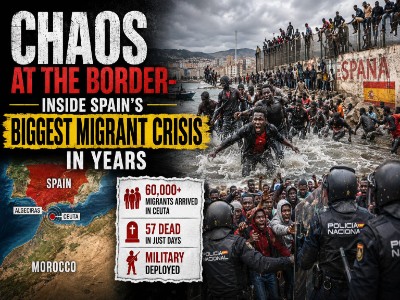
Picture this: a tiny Spanish territory of just 84,000 people suddenly finds nearly 60,000 migrants pouring across its border within 48 hours. That's exactly what happened in Ceuta, Spain's small North African enclave, last week, and the fallout is still shaking European politics as you read this.
What actually happened
Starting Thursday last week, an estimated 50,000 to 60,000 migrants rushed the border between Morocco and Ceuta, many swimming across in wetsuits, using inflatable boats, or pushing and climbing through the border fence. It was, by most accounts, the largest single mass crossing this enclave has ever seen. The scale completely overwhelmed Spain's Guardia Civil border officers, and the Spanish Army was called in to provide logistical and surveillance support.
The human cost was severe. Spanish officials confirmed at least 72 deaths on their side of the border, with local officials in Ceuta putting the number as high as 86 to 88, while at least 11 more people reportedly died on the Moroccan side. Most victims drowned attempting the sea crossing, while others were crushed trying to climb the breakwater along the border fence. More than a thousand people needed medical treatment for exhaustion and injuries.
The good news, if there is any in this story, is that the crisis eased relatively quickly. Spanish authorities say the vast majority, roughly 69,500 people by some estimates, voluntarily returned to Morocco within just a few days, since those who entered Ceuta irregularly couldn't legally travel onward to mainland Spain or the rest of Europe's passport-free Schengen zone. To prevent a repeat, Spain installed a 500-metre floating barrier off the Ceuta coastline.
Why did this happen?
This is where things get murky, and where different parties tell very different stories. Spain's government has flatly called the crossing a violation of its territorial integrity. Some Spanish and European voices have suggested Morocco may have deliberately allowed, or even quietly encouraged, the surge, possibly as a form of diplomatic pressure tied to Spain's stance on unrelated geopolitical issues, including its vocal opposition to the war in Iran and its historic disputes with Morocco over sovereignty of Ceuta and Melilla, territories Morocco has claimed since gaining independence in 1956. It's worth being clear that this remains an allegation and a subject of ongoing speculation, not a confirmed fact, and Moroccan authorities haven't accepted this framing.
There's also a domestic legal angle. The surge came shortly after a ruling by Spain's Supreme Court that barred authorities from summarily deporting migrants who arrive by sea without following due legal process. Some experts believe this ruling may have been misinterpreted, possibly by migrants or human traffickers, as a signal that reaching Ceuta guaranteed a path to staying in Spain, even though the actual ruling was far narrower than that.
Europe's messy, divided response
The crisis quickly became a European problem, not just a Spanish one. Twenty-two EU member states signed a joint letter demanding coordinated emergency talks, and interior ministers held a video conference this week to discuss the situation. But the response from fellow European countries frustrated Madrid rather than reassured it. Italy temporarily reintroduced border checks on travel from Spain, and France's Interior Minister ordered extra checks along the France-Spain border, both moves that effectively punished Spain rather than supporting it during the crisis.
Spanish Prime Minister Pedro Sánchez didn't hold back, publicly criticising what he called a selfish, polarising, and unlawful reaction from some EU partners, and pointedly noting that Spain had backed other European nations during their own past migration crises and now expected the same solidarity in return. Spain's Foreign Minister went further, sharply criticising Italy specifically for what he described as amplifying misinformation about the crisis.
Why this matters beyond Spain
This episode has reignited one of Europe's most persistent and divisive political debates: how should the EU handle migration at its external borders, and does solidarity between member states actually exist when a crisis hits home? Ceuta and its sister enclave Melilla represent the European Union's only land border with Africa, making them a recurring flashpoint for exactly this kind of standoff, this isn't the first mass crossing attempt these territories have witnessed, though it is by far the deadliest and largest.
For now, the immediate emergency in Ceuta has calmed considerably, but the diplomatic wounds it opened between Spain and some of its European neighbours, along with unresolved questions about Morocco's role, suggest this story isn't over. It's a stark reminder that Europe's migration challenges remain as unresolved and politically combustible as ever, and that a small stretch of coastline in North Africa can still trigger a continent-wide crisis within a matter of days.
_1200x675.jpeg)


Share Your Comments
Related Posts
_400x300.jpeg)
The Water Crisis Is Not a Future Problem — It’s a Present Disaster
Old agricultural land slowly turning into construction sites, and families who are neither fully rural nor truly urban