Every Dog Has His Day - Except the One in the Kitchen
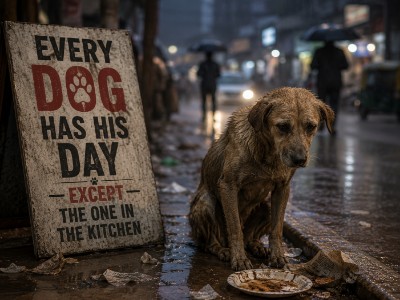
Before the gas oven and electricity changed everything about how humans cooked, there was a dog. A small, low-slung, crooked-legged dog, bred for a single purpose so exhausting and so thankless that history barely bothered to record it. Not because the dog wasn't important. It was essential, present in almost every large kitchen in Britain for nearly three centuries. History forgot it because nobody thought it was worth remembering.
हिंदी में पढ़ें: हर कुत्ते का दिन आता है — रसोई वाले कुत्ते का कभी नहीं
It was the turnspit dog. And its story is one of the most quietly disturbing things the human-animal relationship has ever made.
The Job No Human Wanted
Before the turnspit dog existed, someone had to turn the roasting spit by hand over an open fire for hours at a time. That someone was usually the lowest person in the kitchen hierarchy, often a young boy, crouching behind a bale of wet hay for protection against the heat, sweating through an endless rotation so that the meat cooked evenly. It was dangerous, miserable work.
Then someone realized you could make a dog do it instead.
The turnspit dog, first mentioned in a 1576 book called Of Englishe Dogs, was bred specifically to run inside a large wooden wheel mounted high on the kitchen wall, connected by a pulley to the roasting spit below. As the dog ran, the wheel turned, the spit rotated, and the meat cooked evenly over the fire. The dog's entire body was engineered around this function: short, crooked legs, a long back, a sturdy frame, and enough stamina to keep moving for hours while the fire burned below.
The zoologist Carl Linnaeus named the breed Canis vertigus, meaning dizzy dog. Charles Darwin himself cited turnspit dogs as a clear example of human genetic engineering, pointing to them as proof that people could selectively breed animals to suit particular needs. What Darwin didn't dwell on was what that need actually cost the animal.
A Sad Life Inside a Wheel
The life of a turnspit dog was built entirely around heat, noise, and repetition. Kitchens were roaring, smoky, chaotic places, and the wheel was mounted as high on the wall as possible to keep the dog from overheating and fainting. That detail alone tells you everything about how this animal was perceived: not as a creature that might suffer, but as a piece of lifeless machinery that might malfunction. Because the job was so grueling, most households kept at least two turnspit dogs working in shifts. One would run while the other rested, then they would swap. Some historians believe this is where the English phrase "every dog has his day" originated, eachdog literally getting its turn in the wheel.
When the dogs slowed down from exhaustion, cooks would sometimes throw a glowing hot coal into the wheel to make them speed up. A 19th-century observer described the animals as "long-bodied, crooked-legged and ugly dogs, with a suspicious, unhappy look about them, as if they were weary of the task they had to do, and expected every moment to be seized upon to perform it." That unhappy look wasn't a temperament problem. It was the face of an animal that had been used so completely for so long that it simply stopped expecting anything else.
On Sundays, the turnspit dog got its one regular break. Families took them to church, not out of any concern for the dog's spiritual wellbeing, but because they made convenient foot warmers in cold pews. There is a famous story from a church in Bath where a bishop delivered a sermon referencing Ezekiel and the wheel. At the third mention of the word wheel, every turnspit dog in the congregation bolted for the door.
Discarded When No Longer Needed
By 1750, turnspit dogs were everywhere in Britain. By 1850, they had become scarce. By 1900, they were gone entirely.
The reason was not a change of heart about how the animals were treated. It was the invention of a cheap mechanical device called a clock jack, which used heat from the chimney to rotate the spit automatically. The moment a machine could do the job, the dog became redundant. Nobody wanted to keep them as pets. They were described as morose and ugly, their personalities shaped by generations of hard, joyless labor. Owning one after 1850 became seen as a sign of poverty rather than practicality.
So they simply stopped being bred. And within a generation, the entire breed disappeared from the Earth.
Today, there is exactly one preserved specimen of a turnspit dog in existence. His name is Whiskey. He stands in a glass display case at the Abergavenny Museum in Wales, still looking, even in taxidermy, faintly suspicious of what is about to be asked of him.
What This Actually Says About Us
The turnspit dog's story is not just an uncomfortable footnote in culinary history. It is a mirror held up to a very consistent human pattern: using something entirely for its utility, discarding it the moment a cheaper alternative arrives, and then barely bothering to remember it was ever there at all.Ironically, the mistreatment of turnspit dogs in Manhattan hotels in the 1850s so appalled a man named Henry Bergh that it set him on a path that eventually led to the founding of the Society for the Prevention of Cruelty to Animals. The SPCA exists, in part, because of what humans did to a small, crooked-legged dog no one thought was worth protecting.
The turnspit dog kept the fires going and the meat turning for nearly three hundred years. It asked for nothing and received almost nothing in return. History forgot it almost completely. The least we can do now is remember it properly.

_1200x675.jpeg)


Share Your Comments
Related Posts

Ex-ISRO scientists rewrote India's space history
Pawan Kumar Chandana and Naga Bharath Daka, Skyroot went from a garage startup to a billion-dollar unicorn in just eight years