Ex-ISRO scientists rewrote India's space history
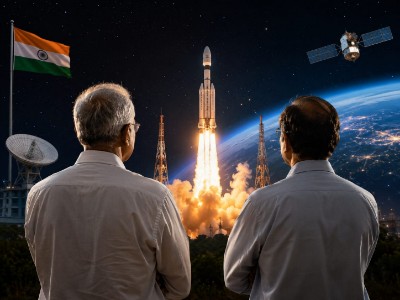
At 2:35 in the morning on 18 July 2026, a seven-story rocket built entirely in Hyderabad by a private Indian startup lifted off from the Satish Dhawan Space Centre in Sriharikota, leaving behind a column of fire and smoke visible for miles. Twelve minutes later, Skyroot Aerospace posted three words on X that said everything: "Hello space, we have arrived."
India had just become the third country in the world where a private company, not a government agency, had successfully placed payloads into orbit. The other two are the United States and China. The moment was not just a corporate milestone. It was the beginning of something that India's space programme has been building toward for years, and that two former ISRO scientists chose to make happen faster by leaving the security of government jobs and betting everything on a startup in a country where nobody had done this before.
The Two Men Who Started It
Pawan Kumar Chandana and Naga Bharath Daka were both Indian Institutes of Technology alumni who had gone on to build careers inside ISRO, the organisation that put India on the global space map. They understood ISRO's strengths, its rigour, its institutional knowledge, its extraordinary achievements, and they also understood its speed, or rather, the pace at which a large government agency necessarily moves when building rockets for national missions.
In June 2018, they left. They founded Skyroot Aerospace in Hyderabad with the conviction that India's growing commercial space ambitions required a private sector that could move faster, build cheaper, and serve the booming global market for small satellite launches. The timing was not accidental. India's IN-SPACe framework, designed to open the country's space sector to private players, was taking shape, and the two founders saw a window that might not stay open indefinitely.
Their first public milestone came on November 18, 2022, when Vikram-S, a single-stage, six-meter, 545-kilogram sounding rocket, lifted off from Sriharikota on Mission Prarambh, meaning beginning, and reached an apogee of 89.5 kilometres, making Skyroot the first private Indian company ever to reach space. The name Vikram was chosen as a tribute to Vikram Sarabhai, the father of India's space programme. The choice was deliberate and reverential, a startup paying homage to the institution its founders had come from while simultaneously racing ahead of it.
Mission Aagaman: The Night Everything Changed
The Vikram-1 rocket lifted off from the Satish Dhawan Space Centre in Sriharikota at 0635 GMT on July 18, 2026, carrying several customer payloads and in-orbit experiments on its maiden orbital mission, dubbed Mission Aagaman, meaning arrival.
Vikram-1 is about as tall as a seven-story building and capable of carrying payloads weighing up to 350 kilograms. The three-stage 22-metre rocket deployed customer payloads into a 450-kilometre low-Earth orbit, making India the third country to achieve orbital launch capability through private enterprise.
A handwritten postcard from Prime Minister Modi bearing the words "Vande Mataram" was also aboard, confirmed by multiple reports. PM Modi said the successful launch would "encourage countless youngsters to dream bigger and innovate fearlessly." The postcard on the rocket was not just symbolism. It was the government's way of saying that what Skyroot had done carried national significance, not just commercial value.
The Money Behind the Mission
A rocket company is not built on idealism alone. In May 2026, just weeks before the launch window opened, Skyroot closed a 60 million dollar funding round co-led by Sherpalo Ventures and GIC, Singapore's sovereign wealth fund, with participation from BlackRock-managed funds, Arkam Ventures, and others. The round valued the company at 1.1 billion dollars, making Skyroot India's first space-technology unicorn, with total capital raised reaching 160 million dollars.
The timing of that funding round, closed weeks before launch, was a calculated signal to global investors: we are about to prove this works. And then they did.
Why This Matters Beyond the Headlines
The global market for small satellite launches is expanding at a pace that ISRO alone, with its government mandates and national priorities, cannot fully serve. India made history as the third country where a private company, not a government agency, has achieved orbital launch, after the United States and China. That third-place ranking in this specific race matters enormously because it means Indian private companies can now offer launch services to global customers with a proven orbital track record, competing directly with SpaceX's Falcon 9 rideshare programme and China's commercial launch providers for the same contracts.
For the dozens of Indian space startups that have emerged since IN-SPACe opened the sector, Vikram-1's success is also a proof of concept for the entire ecosystem. If Skyroot can build an orbital rocket in Hyderabad with 160 million dollars and eight years, the barriers that once made private Indian space seem aspirational rather than achievable have been fundamentally revised downward.
Two former ISRO scientists started a company in 2018. Eight years later, their rocket is in orbit. "It is the dawn of a new space era," Skyroot's commentator said during the launch webcast.
For once, that is not an overstatement.
_1200x675.jpeg)


Share Your Comments
Related Posts

Reservation Hatao Andolan: Why India's Anti-Quota Movement Is Exploding
What started as an online campaign quickly evolved into physical demonstrations in Nagpur, Lucknow, Jaipur..

The Great Job Market Split- 90,000 Tech Jobs Lost: Is India Still a Talent Hub?
Why India saw 90,000 tech layoffs and record employability at the same time, and what it means for your career.

Getting A Job In India Just Got Weirder- Fewer Freshers Wanted, But More Jobs Than Ever
Why India's job market is growing overall even as entry-level opportunities shrink, and what skills-first hiring means for freshers.