India’s Waste May Fuel Indian economy...
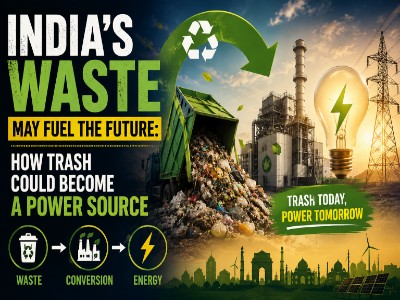
Every day, India throws away millions of tonnes of waste, rotting food from kitchens, leftover crop stubble from farms, sewage from cities, and tonnes of municipal garbage that pile up in landfills. For decades, this was just seen as a problem. A dirty, smelly, expensive problem. But now, the conversation is changing. India's energy crisis is pushing scientists, policymakers, and entrepreneurs to look at all this waste in a completely different way, as fuel.
Why Is This Even Happening Now?
India is the world's third-largest energy consumer, and its hunger for power is only growing. Yet a huge chunk of India's energy, especially cooking gas comes from imports. India imported LPG worth over Rs 1.06 lakh crore in 2024-25, and this alone made up 53% of the entire import expenditure on petroleum products. That is a staggering amount of money leaving the country every year. On top of that, the LPG subsidy burden on the government keeps rising, the total LPG subsidy bill stood at Rs 15,479 crore in FY 2024-25.
Meanwhile, India is simultaneously drowning in waste. India generates over 62–72 million tonnes of municipal solid waste every single year, and most of it simply rots in open dumps. Add to that the enormous amount of agricultural stubble burned by farmers every winter, blanketing North India in toxic smog and you start to see a massive, untapped opportunity just sitting there.
So What Is Bioenergy, Exactly?
Think of bioenergy as the science of taking waste, any organic waste and converting it into usable energy. It is not one technology but a family of them.
The two most talked-about methods right now are gasification and anaerobic digestion. In gasification, agricultural residues like paddy straw or sugarcane waste are burned at very high temperatures with limited oxygen, turning them into a gas called syngas, which can then generate electricity or even be used to produce hydrogen. This technology is the most mature of the lot, it integrates well with farming clusters and, when coupled with carbon capture, can actually produce carbon-negative energy.
Anaerobic digestion works differently. Here, bacteria break down wet organic waste, like food waste, cow dung, or sewage sludge, in the absence of oxygen, producing biogas. This biogas can replace LPG in kitchens or be compressed and used as vehicle fuel. The leftover sludge from this process? It turns into organic fertiliser, which farmers can use instead of costly chemical alternatives.
What Is the Government Doing?
The government is not just watching from the sidelines. The Ministry of New and Renewable Energy launched the National Bioenergy Programme in November 2022, which covers waste-to-energy, biomass, and biogas initiatives. For the fiscal years 2021-22 to 2025-26, the waste-to-energy programme has a budget outlay of Rs 600 crore. The GOBARdhan scheme specifically targets cow dung and farm waste, while the SATAT initiative is pushing compressed biogas as a mainstream fuel.
The Real Potential And Why It Matters
Here is a number that should make every Indian sit up: the potential for compressed biogas production from domestic organic waste alone is estimated at 62 million metric tonnes annually, but current production is less than 1% of that figure. That is an almost entirely untapped reserve of clean energy, sitting in our garbage bins and farm fields.
If India can capture even a fraction of this, the results could be transformative. Cities could reduce their landfill burden dramatically. Farmers would not need to burn stubble anymore, they could sell it to bioenergy plants and earn extra income. The government's massive LPG import bill could shrink. Rural areas could get decentralised, affordable energy. And India's carbon emissions, a key concern as the world watches its climate commitments, would fall.
The Road Ahead
None of this is going to happen overnight. The challenges are real waste segregation at the source is still poor in most Indian cities, scaling up these plants needs serious investment, and awareness among farmers and households remains low. But the direction is clear.
India's waste is no longer just a burden to manage. It is a resource waiting to be unlocked. The country that figures out how to turn its garbage into gas at scale will not just solve an energy problem, it will build a cleaner, more self-reliant future. And for a nation this large, that could change everything.

_1200x675.jpeg)


Share Your Comments
Related Posts
Hanuman Ansh: The Power of Neem Karoli Baba Impacted Jobs and Zuckerberg...
Steve jobs suggested Mark Zuckerberg to go to India and spend time at that same ashram
Reservation Hatao Andolan: Why India's Anti-Quota Movement Is Exploding
What started as an online campaign quickly evolved into physical demonstrations in Nagpur, Lucknow, Jaipur..

The Great Job Market Split- 90,000 Tech Jobs Lost: Is India Still a Talent Hub?
Why India saw 90,000 tech layoffs and record employability at the same time, and what it means for your career.