India Wants To Be The World's AI Powerhouse, But At What Cost To Its Water?
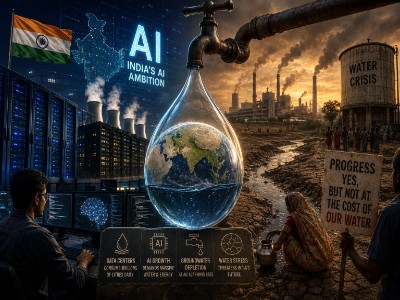
While America's data centre boom keeps hitting resistance at the local level, India has rolled out the red carpet for the exact same industry. And that contrast raises a question every Indian should be thinking about: are we solving someone else's water problem by creating our own?
What's happening in the US right now
Across several American states, ordinary residents have started pushing back hard against AI data centres, and Georgia has become the poster child for this fight. In Fayette County, Georgia, a data centre campus quietly drew nearly 29 million gallons of water through unmetered, undocumented connections over roughly a year, discovered only after nearby homeowners complained about oddly weak water pressure. Around the same time, the county was asking residents to stop watering their lawns because of drought. The backlash was swift: Fayetteville banned new data centres in every zoning district, and at least ten other Georgia municipalities have passed similar restrictions. This isn't isolated to Georgia either, communities in Arizona, Utah, and elsewhere are increasingly resisting fast-tracked data centre projects before anyone fully understands the environmental cost.
India's opposite response: come on in
While American towns are slamming the brakes, India is flooring the accelerator. At the AI Impact Summit 2026 in New Delhi, attended by executives from OpenAI, Google, and Anthropic among others, India's IT minister Ashwini Vaishnaw laid out plans to attract over 200 billion dollars in AI infrastructure investment by 2028. The Union Budget 2026 sweetened the deal further with a 21-year tax holiday, running until 2047, for foreign companies offering cloud services through India-based data centres. States are competing hard too: Uttar Pradesh approved a new Data Centre Policy targeting ₹2 lakh crore in investment, while Gujarat signed a ₹25,000 crore deal with L&T to build a data centre in Dholera. India's data centre capacity, which stood at 1.5 gigawatts by the end of 2025, is projected by Deloitte to grow six-fold to 8-10 gigawatts by 2030.
Why is India doing this?
The honest answer is opportunity and competition. Every country wants a piece of the AI infrastructure boom, since it brings massive investment, jobs, and strategic relevance in the technology race between the US and China. India, with its cost advantages, large talent pool, and pitch around data sovereignty, sees a genuine opening to become a global AI hub rather than simply renting compute from foreign hyperscalers.
But here's the uncomfortable part
India isn't water-rich to begin with. The country holds 18 percent of the world's population but only 4 percent of its freshwater resources, and the World Bank already ranks India among the most water-stressed nations on earth. NITI Aayog's own data shows nearly 600 million Indians already face high to extreme water stress. Even India's own IT minister acknowledged this openly at the summit, admitting that water and power availability is "a major concern" for AI infrastructure.
The numbers make the concern concrete. Data centre water consumption in India is projected to more than double, from around 150 billion litres in 2025 to 358 billion litres by 2030. Karnataka's IT minister told the state assembly that every single megawatt of data centre capacity needs roughly 2.5 crore litres of water annually. Research from WRI India shows that more than half of the country's existing data centres already sit in water-stressed regions, concentrated in cities like Bengaluru, Hyderabad, Chennai, and Mumbai, cities that are also home to millions of ordinary residents competing for the same water. In Andhra Pradesh, rights groups have already raised alarm over a proposed Google data centre near Visakhapatnam, a district with among the lowest groundwater reserves in the state.
Adding to the worry, this year's monsoon forecast came in weaker than expected, the lowest opening forecast in 25 years, according to the India Meteorological Department, right as data centre construction accelerates nationwide. And unlike large infrastructure projects, data centres in India are classified simply as IT or ITeS entities, meaning they skip the standard environmental impact assessments that would normally scrutinise something drawing this much water.
What should readers take away from this?
This isn't a simple story of India "winning" what America is "losing." It's a story of India making a calculated economic bet, chasing a genuinely valuable slice of the global AI economy, while simultaneously walking into a resource conflict it hasn't fully planned for. The investment, jobs, and technological relevance are real. So is the risk that thirsty data centres in already-stressed cities could end up competing directly with ordinary households for the same shrinking water supply. As India races to become an AI superpower, the real test won't be how much investment it attracts, but whether it can grow this industry without draining the wells of its own people.

_1200x675.jpeg)


Share Your Comments
Related Posts
Reservation Hatao Andolan: Why India's Anti-Quota Movement Is Exploding
What started as an online campaign quickly evolved into physical demonstrations in Nagpur, Lucknow, Jaipur..

The Great Job Market Split- 90,000 Tech Jobs Lost: Is India Still a Talent Hub?
Why India saw 90,000 tech layoffs and record employability at the same time, and what it means for your career.
Getting A Job In India Just Got Weirder- Fewer Freshers Wanted, But More Jobs Than Ever
Why India's job market is growing overall even as entry-level opportunities shrink, and what skills-first hiring means for freshers.