So What if its propaganda maybe India just deserves to see itself win for once
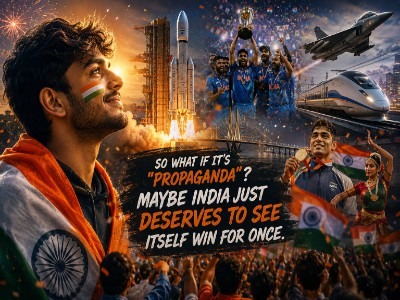
Every time Bollywood propaganda allegations resurface, whether around a war film, a biopic, or a spy thriller, the same debate around nationalist cinema India flares up online. Patriotic Bollywood films get accused of manipulation the moment they celebrate a soldier, a scientist, or a national triumph, and Indian cinema politics has never felt more polarised. But here's a genuinely fair question worth asking honestly: if a film like Dhurandhar movie simply shows India succeeding, shows its heroes as heroes, and shows a nation proud of its own story, what exactly is the crime in that?
Written by Tanya Arora (Entertainment and Lifestyle Writer)
The films everyone's arguing about
This debate exploded fully into the open with Aditya Dhar's Dhurandhar, a spy thriller starring Ranveer Singh that shattered box office records, collecting a staggering ₹1,300 crore, with its sequel already tracking to beat that number. Digital commentators, most notably influencer Dhruv Rathee, called it a calculated "brainwashing" tool serving a political master rather than genuine cinema. Similar accusations have followed films like Uri: The Surgical Strike, The Kerala Story, and biopics on leaders like Atal Bihari Vajpayee and Narendra Modi. The label "propaganda" gets attached almost automatically now, the moment a film leans patriotic, nationalist, or even just positively framed around India's military, government, or history.
Here's the honest counter-question: since when did national pride become a crime?
Every single film industry on earth makes films that celebrate their own country's triumphs, and nobody bats an eye. Hollywood has churned out decades of films glorifying American soldiers and American ingenuity, from Top Gun to Saving Private Ryan to American Sniper, unapologetically framing the US military as heroic. Nobody seriously demands Hollywood stop making those films or accuses Tom Cruise of being a state propagandist. So why does the exact same instinct, showing your own country's soldiers, scientists, and citizens as capable and admirable, suddenly become sinister the moment Bollywood does it?
Supporters of this wave of cinema make a pointed observation here: for decades, a significant chunk of acclaimed Indian cinema leaned almost entirely toward showcasing India's poverty, dysfunction, corruption, and despair, films often praised specifically at international festivals for portraying India's darker realities. If that kind of storytelling was celebrated as "authentic" and "brave," why should films that instead highlight India's successes, its 1971 war heroism, its space programme, its surgical strikes, be dismissed instantly as manipulative propaganda? Isn't that itself a double standard, where showing India badly gets called art, and showing India well gets called manipulation?
The industry has genuinely changed, and maybe that's not the tragedy critics claim
It's true that Bollywood, historically viewed as a largely secular, apolitical creative space, has shifted noticeably over the past decade toward more overtly nationalist storytelling. But shifts in cultural output reflecting a nation's mood aren't automatically sinister, they often just mirror what audiences actually want to watch. And audiences have spoken loudly with their wallets: Dhurandhar, Uri, Gadar 2, these aren't films forced onto reluctant viewers, they're some of the biggest commercial successes in recent Bollywood history. If people are voluntarily filling theatres to watch stories of India's triumphs, that's not indoctrination, that's simply giving the audience content it has been hungry for after years of the opposite.
There's also a fair defence around historical framing: several of these films are based on real events, the 1999 Kargil war, the 2016 surgical strikes, real military and political figures, dramatized, yes, but not invented from nothing. Calling a dramatized-but-real war story "propaganda" while giving a free pass to fictionalised social-issue dramas that take equal creative liberties feels, to defenders of this cinema, like a selectively applied standard rather than a consistent journalistic principle.
A fair note on the other side
It would be incomplete not to mention the genuine counterargument critics raise: they worry these films sometimes blur the line between celebrating India and demonising specific communities or neighbouring countries, citing examples where minority groups or Pakistan are portrayed with heavy-handed villainy rather than nuance. Timing that coincidentally lines up with election cycles has also drawn scrutiny, and some critics argue that state support or tax exemptions given to select films suggest more than organic audience demand at play. These aren't baseless concerns, and reasonable people can genuinely disagree on where patriotic storytelling ends and political messaging begins.
Maybe the real answer isn't choosing a side entirely, but accepting that cinema has always been political, everywhere, always, and that showing India's wins on screen isn't inherently more dishonest than decades of films that showed only its wounds. Whether you call it Bollywood propaganda or simply overdue patriotic Bollywood films, the deeper debate around nationalist cinema India and Indian cinema politics ultimately comes down to one question: if the label gets applied only when a story flatters the country and never when it wounds it, that inconsistency deserves just as much scrutiny as films like Dhurandhar movie themselves.

_1200x675.jpeg)


Share Your Comments
Related Posts
Why Do Devotional Films Lag Behind Despite Bumper Box Office Collections? From 'Jai Santoshi Maa' to 'Hanuman Ansh'
'Bhagavad Gita As It Is'. This is his most authentic translation and commentary on the Gita
Reservation Hatao Andolan: Why India's Anti-Quota Movement Is Exploding
What started as an online campaign quickly evolved into physical demonstrations in Nagpur, Lucknow, Jaipur..

Why Bollywood Gets Roasted For What Tollywood And Hollywood Get Away With
Why Bollywood absorbs disproportionate criticism for content that Hollywood and Tollywood films get away with unscathed.