Getting A Job In India Just Got Weirder- Fewer Freshers Wanted, But More Jobs Than Ever
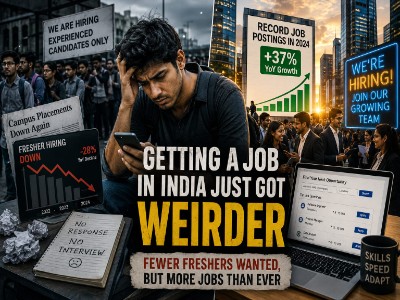
Here's a genuinely confusing paradox playing out in India's job market right now: companies are hiring, in fact hiring rebounded 14 percent in July alone, yet if you're a fresh graduate sending out applications and hearing nothing back, that frustration is completely real too. Understanding why both things are true at once might be the single most useful career lesson for anyone entering India's workforce in 2026.
The numbers tell two different stories
On one hand, India's overall white-collar hiring climbed steadily this year, and AI-related hiring specifically has been on an absolute tear, jumping somewhere between 32 to 50 percent depending on which report you look at, with roughly 3.8 lakh AI-focused roles projected for 2026 alone. Global Capability Centres, the India offices of multinational giants like Google, Amazon, and JP Morgan, are expected to add over 1.2 lakh net new roles this year, often better paying and more technically demanding than traditional IT services jobs.
On the other hand, entry-level tech openings for candidates with zero to two years of experience actually fell 44 percent year-on-year by June 2026. Employers are conducting more interviews per hire than before, and the years of experience being demanded even for supposedly junior roles has climbed significantly. So the honest picture is this: there are more jobs overall, but a shrinking number of them are the traditional "we'll train you from scratch" positions that generations of Indian graduates relied on.
Why is this happening?
The simplest explanation is that AI has started eating exactly the kind of work junior employees used to be hired to do. Basic coding assistance, documentation, simple data entry, first-draft QA testing, tasks that used to justify hiring five fresh graduates can increasingly be handled by one experienced developer working alongside AI tools like GitHub Copilot or similar coding assistants. This isn't a temporary blip tied to a slow economy, industry analysts are increasingly describing it as a structural, permanent shift in how technical teams are built, not something that reverses once hiring picks back up again.
So what exactly are employers looking for instead?
This is genuinely the most important part for anyone job-hunting right now. Employers have moved decisively away from screening candidates purely by degree or college pedigree, and toward what's being called skills-first recruitment. Project-based hiring, evaluating candidates on actual portfolios, internships, hackathons, and demonstrated proof-of-work rather than just marksheets, has grown nearly 38 percent over the past year. Employer intent to hire freshers is actually still healthy, around 73 percent for the first half of 2026, but that appetite is increasingly concentrated on candidates who can prove they've already built something real, rather than those who simply have a good CGPA and a completed degree.
There's a second layer to this too, and it's one that often gets overlooked: soft skills matter more, not less, in an AI-heavy workplace. Multiple industry reports point out that while AI can now write code, analyse data, and draft reports competently, it still can't walk into a room, read a client's mood, build genuine trust, or guide a team through a messy, ambiguous project. As routine technical work gets automated, the ability to communicate, collaborate, and lead is becoming a more valuable differentiator, not a soft, optional extra.
What should you actually do with this information?
If you're a student or recent graduate, the practical takeaway is fairly concrete. Don't just complete your degree and wait, actively build something you can show: a personal project, a genuine internship, a hackathon entry, anything that proves you can apply your skills rather than merely describe them on a resume. Specifically pairing core technical skills with AI fluency, understanding how to actually use AI tools in your workflow rather than fearing them, has become one of the clearest ways to stand out, since demand for candidates who combine both is growing significantly faster than demand for either skill alone.
It's also worth remembering that opportunity isn't limited to the traditional IT sector anymore. Non-IT sectors like BPO, hospitality, insurance, and healthcare have actually been driving a meaningful share of fresh hiring growth this year, often with less brutal competition than the oversaturated software engineering track.
The bigger picture
What India's job market is really signalling in 2026 isn't that opportunities are disappearing, it's that the old, comfortable assumption, get a degree, apply, get trained on the job, has quietly stopped being reliable. The market isn't rejecting beginners outright, it's simply pricing genuine readiness more explicitly than it used to. For anyone building a career right now, the honest advice is straightforward: your degree still opens the door, but increasingly, it's what you can actually demonstrate that decides whether you get to walk through it.
_1200x675.jpeg)


Share Your Comments
Related Posts
Hanuman Ansh: The Power of Neem Karoli Baba Impacted Jobs and Zuckerberg...
Steve jobs suggested Mark Zuckerberg to go to India and spend time at that same ashram

Reservation Hatao Andolan: Why India's Anti-Quota Movement Is Exploding
What started as an online campaign quickly evolved into physical demonstrations in Nagpur, Lucknow, Jaipur..
The Great Job Market Split- 90,000 Tech Jobs Lost: Is India Still a Talent Hub?
Why India saw 90,000 tech layoffs and record employability at the same time, and what it means for your career.