India Calls Pakistan Out at the UN — Here Is What Actually Happened and Why It Matters...
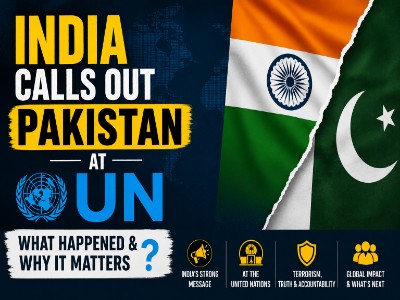
Every year, the United Nations Security Council holds a formal debate where countries are supposed to sit together and discuss one thing, how to protect ordinary civilians caught in armed conflicts around the world. Wednesday's session, held in New York, was supposed to be exactly that. But what unfolded inside the chamber tells a much larger story about the simmering tensions between India and Pakistan.
Written and published by Deepak Sriram, Delhi 21 May 2026, Thursday, 7:055 PM IST
Pakistan's representative, during the debate, raised the issue of Jammu and Kashmir. India's response was immediate, sharp, and backed by numbers.
Why Did India React So Strongly?
India's Permanent Representative to the UN, Ambassador Harish Parvathaneni, took the floor and did not mince words. His core argument was straightforward, Pakistan had walked into a debate about protecting civilians and used it to point fingers at India, when Pakistan itself has a documented record of killing civilians, both within its own borders and beyond them.
This is not the first time Pakistan has tried to raise Kashmir at a UN forum. It is, however, one of the most data-heavy and historically grounded responses India has given back.
What the Numbers Say
Ambassador Parvathaneni cited figures from UNAMA, the United Nations Assistance Mission in Afghanistan, which is the UN's own monitoring body, not an Indian source. According to UNAMA's findings for just the first three months of 2026, Pakistani military forces were responsible for 750 civilian deaths and injuries inside Afghanistan, caused primarily through airstrikes. Out of 95 documented incidents of civilian casualties in that period, UNAMA attributed 94 directly to Pakistani security forces.
He also brought up a specific incident that shook the international community in March 2026, during Ramadan, Pakistan conducted an airstrike on the Omid Addiction Treatment Hospital in Kabul. The strike killed 269 civilians and injured 122 more. A hospital. During Ramadan. At the time of evening prayers, when patients were stepping out of the mosque attached to the facility.
Beyond 2026, he pointed to the fact that over 94,000 Afghan civilians have been displaced because of cross-border violence attributed to Pakistan.
Going Back to 1971
Parvathaneni did not stop at recent data. He went back to 1971, the year Pakistan's own army carried out what historians and international courts have since described as one of the worst atrocities since World War II. Operation Searchlight, the codename for the military crackdown on the Bangladeshi nationalist movement in then-East Pakistan, involved the mass killing of civilians and the systematic rape of an estimated 400,000 women by the Pakistani army. Bangladesh, born out of that bloodshed, stands as a permanent historical record of what happened.
The point India was making was clear, a country with this history, and with this present-day track record in Afghanistan, has no standing to lecture the world about civilian protection.
What Does This Mean Going Forward?
This exchange is significant for a few reasons. First, it signals that India is no longer content with simply rejecting Pakistan's Kashmir references at the UN. India is now going on the offensive, using verified international data to build a legal and moral case against Pakistan's conduct. Second, it puts Pakistan in a difficult position, the figures Parvathaneni cited come from the UN's own mission in Afghanistan, which Pakistan cannot easily dismiss.
No resolution was passed and no formal council action was taken from Wednesday's debate. These open debates are not binding. But they are on the record. Every word spoken, every figure cited, becomes part of the permanent UN documentation and that matters when the broader conversation about accountability and international law eventually moves forward.
For India, Wednesday was not just a rebuttal. It was a statement of intent.



Share Your Comments
Related Posts

IPL 2026 - Riyan Parag Asks Commentators to Focus on Cricket — And He's Not Wrong...
Parag has been in the spotlight since his teenage years. He was branded as someone with "attitude problems" early in his career by sections of the media and commentary circle. He fought back, not with press conferences, but with runs and performances.
India’s Waste May Fuel the Future...
India is simultaneously drowning in waste. India generates over 62–72 million tonnes of municipal solid waste every single year, and most of it simply rots in open dumps. Add to that the enormous amount of agricultural stubble burned by farmers every winter, blanketing North India in toxic smog
Iran Eyes Google, Meta Cable Fees — India May Feel the Impact...
An Iranian lawmaker, Mostafa Taheri, floated a figure of $15 billion annually as potential fee revenue from these 17 cables crossing the strait. On top of that, Iran has formally established a new body called the Persian Gulf Strait Authority