Iran Eyes Google, Meta Cable Fees — India May Feel the Impact...
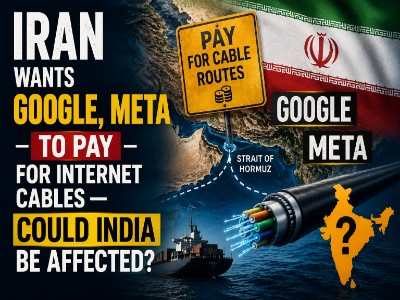
Think about the last time you opened Instagram, paid a bill through your bank's app, or joined a video call on Google Meet. All of that happened because of thin fibre-optic cables lying silently on the ocean floor, thousands of metres below the surface. Right now, Iran is trying to charge the world's biggest tech companies just to keep using those cables and the situation is more complicated, and more consequential, than it sounds.
Written by Deepak Sharma, Delhi, Published by Deepak Sriram, 19 May 2026, Tuesday, 6:15 PM IST
What Exactly Has Iran Said?
On May 9, 2026, Iran's military spokesperson Ebrahim Zolfaghari posted on X in plain language: "We will impose fees on internet cables." Iranian state-linked media then named the targets directly— Google, Meta, Microsoft, and Amazon. According to reports, seven major undersea cables run through the Strait of Hormuz, and Iran now wants to treat them the way toll booths treat highway drivers.
An Iranian lawmaker, Mostafa Taheri, floated a figure of $15 billion annually as potential fee revenue from these 17 cables crossing the strait. On top of that, Iran has formally established a new body called the Persian Gulf Strait Authority (PGSA) to oversee vessel and cable movements through the waterway.
Why Did Iran Do This?
To understand the why, you have to look at what has been happening in the region since February 2026. Iran has imposed a near-total closure over the Strait of Hormuz since the outbreak of war with the US and Israel on February 28. Iran has already been demanding fees from ships wishing to pass through, the cable levy is an extension of the same strategy.
Iran is under crushing economic sanctions, its oil revenues are severely constrained, and the war has left it looking for new sources of leverage and income. Iranian state-linked media have been framing the undersea cables as a strategic asset, similar to how the country has long leveraged oil shipping routes. Simply put, Iran is cornered economically, and it is using geography as its weapon.
Why Can't Google or Meta Just Pay?
Here is where things get legally tangled. These are demands that U.S. companies are legally barred from meeting under American sanctions law. The U.S. Treasury's Office of Foreign Assets Control (OFAC) has formally warned that paying any fee to Iran for Hormuz passage, in any form, including digital assets or informal swaps, exposes companies to serious sanctions risk. Non-American companies face secondary sanctions too. So the tech giants are stuck: pay Iran and break American law, or refuse and risk having their cables disrupted.
International law is also on the side of the companies. The UN Convention on the Law of the Sea includes a transit passage principle that protects the uninterrupted flow of international navigation and communications through straits like Hormuz. Iran has signed that convention but never ratified it, and legal experts say its claims over these cables remain on shaky ground.
What Could This Mean for India?
India is not a bystander here. Experts warn that damage or disruption to these cables could cause serious disruption across the Middle East, India, and parts of East Africa, affecting banking, outsourcing operations, energy communications, and general connectivity. India's IT sector, which relies on real-time data links with clients in Europe and the Gulf, would be among the first to feel the pressure. Online banking, streaming, and even stock market systems could face slowdowns or outages if cables are cut or restricted.
Repairing a damaged undersea cable requires specialised deep-sea vessels, ships that may now require Tehran's permission to even enter the Strait of Hormuz. Repairs typically take weeks to months. Satellite alternatives like Starlink exist but cannot absorb anywhere near the volume these cables carry.
Where Does This Stand Right Now?
No fees have been collected yet, and most analysts describe Iran's declarations as leverage rather than an immediately enforceable policy. A ceasefire has been in place since April 8, but it remains fragile, with U.S. President Donald Trump describing it as having a "one percent chance" of surviving. As long as the broader US-Iran standoff remains unresolved, these threats will continue to hang over the cables that quietly keep the digital world running, including ours.
_1200x675.jpeg)


Share Your Comments
Related Posts
Reservation Hatao Andolan: Why India's Anti-Quota Movement Is Exploding
What started as an online campaign quickly evolved into physical demonstrations in Nagpur, Lucknow, Jaipur..
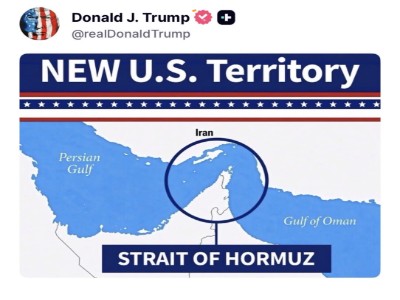
New U.S. Territory - Trump's Wildest Map Yet Just Rattled Global Oil Markets
Trump's bizarre claim over the Strait of Hormuz as "New U.S. Territory" has deepened tensions with Oman and...

The Great Job Market Split- 90,000 Tech Jobs Lost: Is India Still a Talent Hub?
Why India saw 90,000 tech layoffs and record employability at the same time, and what it means for your career.