Trump and Xi Meet Here Is What Changed, What Was Agreed, and Why It Matters...
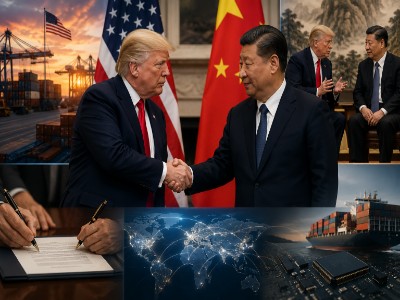
When two of the most powerful leaders in the world sit down together after nine years, the world pays attention. That is exactly what happened this week in Beijing. U.S. President Donald Trump paid a state visit to China, the first visit by an American president in nine years, and Trump's second trip to Beijing since November 2017.
Chinese President Xi Jinping received him at the Great Hall of the People, one of China's most significant political buildings, with a formal ceremony, a state banquet, and a visit to the historic Temple of Heaven together.
But this was not just diplomatic ceremony. There was a real reason this meeting had to happen and the reason goes back to one of the most damaging trade wars in recent history.
Why Did This Summit Happen?
Just over a year ago, the U.S.-China relationship was far rockier. Trump's tariffs on China sparked a tit-for-tat trade war, leading both countries to raise tariffs on each other's goods to over 100 percent. The two sides also clashed over rare earth minerals, semiconductors, student visas, fentanyl precursor chemicals, and Chinese soybean imports. In simple terms, both economies were bleeding, global supply chains were shaken, and neither side could afford to keep escalating.
China controls approximately 85 percent of global rare earth processing and more than 90 percent of magnet production, the very materials that go into everything from smartphones to fighter jets. When Beijing threatened to cut off those supplies, it hit Washington hard. That pressure, combined with economic strain on both sides, brought the two leaders back to the table. The Beijing summit was essentially both countries deciding that enough was enough.
What Was Agreed?
The two presidents agreed on a new vision of building a constructive China-U.S. relationship of strategic stability, intended to provide strategic guidance for bilateral relations over the next three years and beyond, promoting the steady, sound, and sustainable development of China-U.S. relations. In plain terms, they agreed to stop treating each other purely as rivals and work toward a more stable, predictable relationship.
Their trade teams reached "overall balanced and positive outcomes" at preparatory meetings. Xi confirmed that China's door to opening up will only open wider, and both sides discussed expanding market access for American businesses and deepening cooperation in trade, agriculture, and tourism. A dozen top American business leaders, including Elon Musk, Tim Cook of Apple, Jensen Huang of Nvidia, and Boeing's CEO, were part of Trump's delegation, signalling that real commercial deals were very much on the table.
On Iran, both leaders agreed that the Strait of Hormuz must remain open to support the free flow of energy, and Xi expressed interest in purchasing more American oil to reduce China's dependence on the Strait.
On Taiwan, Xi was direct, he stressed that "the Taiwan question is the most important issue in China-U.S. relations" and warned that mishandling it could put "the entire relationship in great jeopardy." The White House did not publicly comment on Taiwan in its official readout.
What Happens Next?
Trump invited Xi to the White House for a return visit on September 24. Importantly, all agreements remain reversible, tariffs, rules, and restrictions can be reinstated by either side, and several commitments are set to expire or require renewal in late 2026, meaning this is the beginning of a process, not a final resolution.
For countries like India, which sits between these two giants both geographically and economically, a stable U.S.-China relationship reduces the risk of sudden supply chain shocks, volatile commodity prices, and regional military tensions. China's foreign ministry summed it up plainly, the interactions between the two presidents have injected much-needed stability and certainty into the world. Whether that stability holds will depend on what both sides do next.



Share Your Comments
Related Posts
Why sudden shifts in power have become the new norm In American politics...
White House. Political analysts typically focus on the president and his party's immediate decisions whenever voters turn against the party in power.
.jpeg)
Stalin vs Mamata: Two Different Faces of Politics...
Stalin said, “We accept the mandate.” Mamata said...