Why Elon Musk Calls Neuralink Jesus-Level Technology...
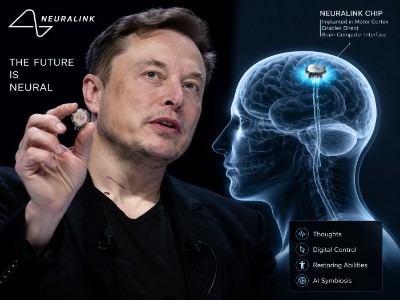
On May 18, 2026, Elon Musk was speaking at an international technology summit in Tel Aviv, Israel, via video link. Someone asked him to name a breakthrough that the world is not paying enough attention to. He skipped past his rocket company and his electric cars, and went straight to Neuralink, the brain-chip company he co-founded in 2016. Then he said something that stopped people mid-scroll.
Written and published by Deepak Sriram, Delhi
"Restoring control of people who are tetraplegics and restoring sight, I think, are pretty big deals. They're sort of what I might call Jesus-level technologies."
He later took it further on X, the social media platform he owns. "Neuralink is a much bigger breakthrough than most people realise. Enabling people to control a computer with their mind and the completely blind to see are Jesus-level miracles," he posted.
The internet did not take it quietly.
Why Did He Say This?
To understand why Musk used this language, you have to understand what Neuralink actually does. The device is a small chip, roughly the size of a coin, placed inside the skull. It reads electrical signals from brain neurons and translates them into digital commands, allowing users to control devices or regain lost functions through the power of their mind.
The first human to receive the implant, Noland Arbaugh, a quadriplegic, received it in January 2024 and has since used the device to play video games, send messages, and design 3D models, all with his mind. As of January 2026, 21 participants were enrolled in trials worldwide.
Musk's point was simple: a man who could not move his body is now designing objects on a computer using only his thoughts. In his view, that is the kind of result that, in any earlier era of human history, would have been called a miracle. He said so out loud, at a public forum, without hesitation.
What Is Neuralink Actually Working Toward?
Beyond helping people with paralysis, Neuralink is developing a second product called Blindsight. It is expected to be tested on its first patient by the end of 2026. The technology uses ultra-fine threads to stimulate the brain's visual cortex directly, creating perceptions of light and shapes, effectively bypassing damaged or missing eyes entirely.
Neuralink has raised around $1.29 billion to date and is currently valued at nearly $9 billion. The company has announced plans to begin high-volume production of its devices in 2026 and move toward a largely automated surgical procedure.
Why Did It Cause Backlash?
Criticism came quickly. Some pointed out that calling engineered solutions "miracles" mixes up human ingenuity with a divine act and blurs what the implants actually do for the public. Religious communities felt the comparison was disrespectful. Scientists cautioned that Musk's future claims have not been independently verified in peer-reviewed data and remain projections rather than established results.
Regulators, too, have kept a firm boundary. The FDA's current approvals cover only investigational use for patients with severe neurological conditions, there is no approval for healthy individuals.
What Does This Mean for the Future?
If Neuralink delivers even half of what it has promised, the medical world will look very different. People with ALS, spinal injuries, or complete blindness could regain communication and independence. The bigger question, one that no law in any country has fully answered yet, is what happens when this technology moves beyond patients and becomes available to healthy people by choice.
That is the conversation Musk may have intended to start. Whether or not his choice of words was appropriate, the technology behind them is very real, and it is moving faster than most people realise.




Share Your Comments
Related Posts

India’s Waste May Fuel the Future...
India is simultaneously drowning in waste. India generates over 62–72 million tonnes of municipal solid waste every single year, and most of it simply rots in open dumps. Add to that the enormous amount of agricultural stubble burned by farmers every winter, blanketing North India in toxic smog