16th Finance Commission- Are Better-Performing States Being Shortchanged?
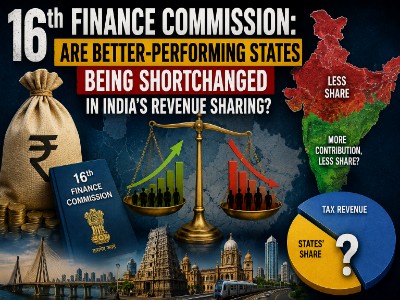
Every five years, a constitutional body quietly decides something that affects every Indian, how much money each state gets from the taxes collected by the Centre. That body is the Finance Commission, and its latest edition, the 16th Finance Commission chaired by economist Dr. Arvind Panagariya, has stirred up a debate that goes to the heart of Indian federalism.
Written and published by Deepak Sriram, Delhi, 26 May 2026, Tuesday, 3:25 PM IST
The 16th Finance Commission submitted its report for the award period 2026 to 2031, and the recommendations were tabled in Parliament alongside the Union Budget 2026–27. The report signals a significant shift from entitlement-based transfers to compliance-driven fiscal federalism linking how much a state receives to its economic performance, fiscal discipline, and transparency.
Why This Happened And What Changed
To understand the controversy, one needs to understand how the formula works. The Centre collects taxes from all over the country and distributes a portion among states. The 16th Finance Commission has retained the states' share at 41 percent of the divisible pool of central taxes, unchanged from the previous 15th Finance Commission. The bigger change is in how that 41 percent gets distributed among the states. The new formula introduces a 10 percent weight for a state's contribution to national GDP, a new criterion that rewards states with higher economic output. At the same time, the earlier tax and fiscal effort criterion, which had previously incentivised states to collect their own taxes efficiently and manage their finances responsibly, has been removed entirely.
This is where the equity problem begins. States like Tamil Nadu, Karnataka, Kerala, and Andhra Pradesh generate a significant portion of India's GDP, collect taxes well, and have controlled their population growth over decades. Under the old criteria, they were at least partially rewarded for that. The combined share of southern states— Andhra Pradesh, Karnataka, Kerala, and Tamil Nadu has declined significantly over successive Finance Commission periods, while major beneficiary states gained larger shares.
Southern states argue that they are being penalised despite their success in population control and governance reforms. The 2011 Census population data is being used as the base, meaning states that controlled population growth earlier see their population weight frozen in time, while states with larger, faster-growing populations receive a proportionally higher share.
The Core Equity Problem
Overall devolution transfers have also been falling they peaked at 35.6 percent of gross tax revenue under the 14th Finance Commission, fell to 34.4 percent under the 15th, and are now estimated at 32.7 percent for 2026–27. Additionally, the tax effort and fiscal discipline criterion has been dropped entirely, despite the fact that it had previously promoted fiscal responsibility among states.
States had demanded that their share be raised from 41 percent to 50 percent, partly because the Centre has been increasingly relying on cesses and surcharges, which sit outside the divisible pool and therefore are not shared with states at all. That demand was not accepted.
For poorer states, however, the picture is different. The Commission gives the highest weight to income distance ensuring larger transfers to poorer states such as Uttar Pradesh, Bihar, Madhya Pradesh, and West Bengal. This reflects the principle of equalising developmental opportunities across the country. But critics argue that while the intent is sound, the arbitrary weights assigned to each criterion are where the problem lies with no clear, rule-based justification for why one parameter gets a certain percentage and another does not.
What This Means Going Forward
Total grants recommended by the 16th Finance Commission stand at Rs 9.47 lakh crore for the period 2026 to 2031. The Commission has also placed strict fiscal conditions on states capping their fiscal deficit at 3 percent of GSDP, mandating the end of off-budget borrowings, and pushing for privatisation of electricity distribution companies.
Welfare schemes such as Gruha Lakshmi in Karnataka or Majhi LadkiBahin in Maharashtra may now face funding scrutiny under the new guidelines that warn against unconditional cash transfers to large, untargeted beneficiary bases.
The deeper question this raises one that analysts and policymakers across the country are now openly discussing is whether the Finance Commission's primary role is to equalise fiscal capacity across unequal states, or to reward those that perform well economically. The 16th Finance Commission has moved the needle toward the latter. Whether that is the right balance for a federal democracy as diverse and unequal as India remains a debate that is far from settled.


Share Your Comments
Related Posts

India and the US Press Reset- What the Jaishankar-Rubio Talks Really Mean for India...
The biggest takeaway for the average Indian, whether a business owner, a student planning to go abroad, or a professional in the IT sector is the trade deal. Marco said at the joint press conference that the pending India-US trade deal is on the "verge" of happening

George Soros and His 5 Propaganda Campaigns Against India — Why India Must Stay Alert...
The Guardian is a partner of Project Syndicate, a network of over 500 media outlets across 156 countries, primarily funded by George Soros

India Calls Pakistan Out at the UN — Here Is What Actually Happened and Why It Matters...
Pakistan conducted an airstrike on the Omid Addiction Treatment Hospital in Kabul. The strike killed 269 civilians and injured 122 more.