India and the US Press Reset- What the Jaishankar-Rubio Talks Really Mean for India...
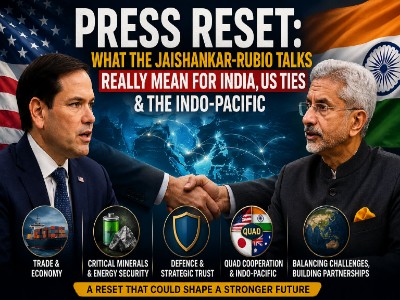
When US Secretary of State Marco Rubio landed in Kolkata on Saturday and made his way to New Delhi, it was not just a routine diplomatic visit. It was, in many ways, a message, that despite a difficult year between India and the United States, both countries still need each other too much to let the relationship slide further.
Written and published by Deepak Sriram, Delhi, 26 May 2026, Tuesday, 2:50 PM IST
The last year had not been easy for India-US ties. Washington imposed stiff tariffs on Indian goods, sided with Pakistan's military leadership during the May 2025 India-Pakistan conflict, hiked the H-1B visa fee, and tightened immigration rules, all of which had quietly but steadily damaged the trust between the two nations. So when Rubio sat down with External Affairs Minister S. Jaishankar at Hyderabad House on May 24, there was a lot of ground to cover.
The Trade Deal That India Has Been Waiting For
The biggest takeaway for the average Indian, whether a business owner, a student planning to go abroad, or a professional in the IT sector is the trade deal. Marco said at the joint press conference that the pending India-US trade deal is on the "verge" of happening, adding that the two sides had made "tremendous progress" and that he expects a US trade delegation to visit Bharat very soon to finalise the remaining text.
The goal, as discussed during the talks, is to bring the volume of trade between the two countries to 500 billion dollars by 2030. For India, this matters enormously. A finalised trade agreement would mean lower tariffs on Indian exports such as pharmaceuticals, textiles, and technology services, directly benefiting Indian manufacturers and workers.
The H-1B and Green Card Concern — Jaishankar Raised It Directly
One issue that hits close to home for millions of Indian families is the US immigration crackdown. Jaishankar directly apprised Rubio of the difficulties faced by legitimate Indian travellers regarding visa issuance. He made clear that while India is willing to cooperate on curbing illegal migration, legal mobility especially for business, technology, and research professionals, must not be affected as a consequence.
The reason this came up at such a high-level meeting is significant. On May 22, 2026, the US Department of Homeland Security announced that USCIS will now process Green Card applications domestically only under "extraordinary circumstances," meaning most foreign nationals including thousands of Indian professionals will have to return to their home country to apply through consular processing. This has created real hardship for people who have lived and worked in the US for years. Rubio responded by reaffirming the value Indian professionals bring to America, noting that Indian companies have invested over $20 billion into the US economy. He defended the new policy as part of a broader immigration reform, not something aimed at India specifically.
Terror and Tahawwur Rana — A Landmark Legal Win
Jaishankar publicly acknowledged at the press conference the extradition from the United States to India of a key planner of the 26/11 Mumbai attacks, a moment he described as a reflection of strong counter-terrorism cooperation between the two countries. India's position on terrorism, he stated, remains one of zero tolerance.
That person is Tahawwur Hussain Rana. The US extradited Rana, a Canadian citizen of Pakistani origin, to stand trial in India on ten criminal charges, including conspiracy, murder, and commission of a terrorist act, related to the 2008 Mumbai attacks carried out by Lashkar-e-Taiba. The extradition was executed under the India-US Extradition Treaty signed in 1997. After years of legal battles and last-ditch petitions, India finally got one of the key accused on its soil, a direct result of sustained diplomatic pressure backed by treaty law.
What This Means Going Forward
Rubio summed it up clearly after the talks: "India-US relations have not lost momentum and will come out much stronger in the coming years." That is not just diplomatic language. The meeting covered defence cooperation, civil nuclear energy, critical minerals, energy supply, Indo-Pacific security through the Quad framework, and the West Asia crisis. Marco also conveyed a personal invitation from President Trump to Prime Minister Narendra Modi to visit Washington later this year.
For Indian citizens, the practical outcomes of this visit, if the trade deal is signed, if legal mobility is protected, and if defence cooperation deepens will be felt in jobs, exports, and the safety of Indians living and working abroad. The talks did not solve everything. But they made clear that both countries, despite their differences, are choosing the path of engagement over distance.


Share Your Comments
Related Posts
_400x300_(1).jpeg)
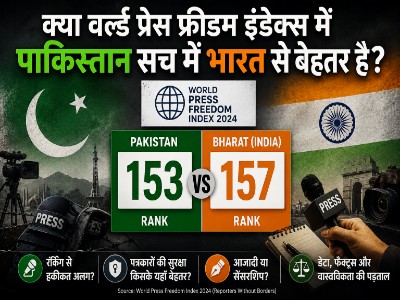
Pakistan Is Happier Than India?
Do you really want to believe that a country facing civil unrest ranks higher than India on an international media or governance index?
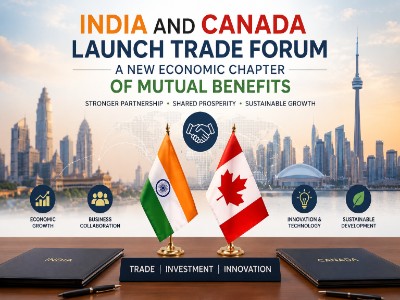
India and Canada Launch Trade Forum — Economic Chapter of mutual Benefits...
The timing is crucial. India and Canada went through a serious diplomatic falling out in 2023, which had nearly finished bilateral trade progress. But the political winds shifted when Canadian Prime Minister Mark Carney took office and visited India in March 2026.

Money Talks: The Top 5 Most Expensive Sports in the World...
Horse racing has been called the sport of kings for centuries, and the finances back that title up completely. Successful stallions can command stud fees of $100,000 to $300,000 per breeding