Even the Ocean Could Not Break Mulla's Courage
The brave Captain Who Gave Away His Life Jacket - The Untold Story of Mahendra Nath Mulla
There is an old tradition of the sea, older than any navy, older than any flag. When a ship is sinking, the captain is the last to leave. Not because someone ordered it. Not because it is written in any regulation.
हिंदी में पढ़ें: महासागर भी नहीं तोड़ सका मुल्ला का साहस
But because a captain's responsibility for the lives under his command does not end when the water starts rising. It ends only when he has done everything that can be done.
On the night of 9 December 1971, Captain Mahendra Nath Mulla of the Indian Navy chose to honor that tradition completely. He gave away his own life jacket to a young sailor who had none. He went back to the bridge of his sinking ship to see if there was anyone left he could save. And then the Arabian Sea took him.
He was only 45 years old. His ship, INS Khukri, remains to this day the only Indian Navy vessel lost in combat since independence. And most Indians cannot tell you his name.
The Man Before the Captain
Mulla was born on 15 May 1926 in Gorakhpur, into a Kashmiri family that was well known in Allahabad's judicial circles. His father was a respected lawyer. His world was expected to be courtrooms and arguments, the kind of career that respectable families steered their sons toward in colonial India.
Mulla chose a differently path. At 20, he joined the Royal Indian Navy as a cadet in January 1946, training in the United Kingdom before being commissioned on 1 May 1948. Over the next two decades, he moved steadily through the ranks with the quiet competence of a man who loved the sea without needing to announce it. He was promoted to Lieutenant Commander in 1958, selected for the prestigious Defence Services Staff College in Wellington in 1961, and promoted to Commander in 1964.
By February 1971, he had been given command of INS Khukri, a Type 14 Blackwood-class anti-submarine frigate, and appointed Flotilla Commander of the 14th Frigate Squadron, overseeing INS Khukri, INS Kirpan, and INS Kuthar. He was an Anti-Submarine Warfare specialist and one of the finest seamen in the Indian Navy.
He was also, according to his daughter Ameeta, a man of unusually calm authority, the kind of person whose composure in a crisis transmitted itself to everyone around him before a single word was spoken.
The Night the Hangor Struck
The 1971 India-Pakistan War began on 3 December 1971. Indian naval intelligence had detected a Pakistani submarine lurking approximately 35 miles southwest of Diu harbour in the Arabian Sea. The submarine was PNS Hangor, a French-built Daphné-class vessel, and it had been quietly hunting Indian ships for days.
The 14th Frigate Squadron was dispatched to locate and destroy it. The mission was already complicated before it began. INS Kuthar's boiler room was under repair in Bombay, leaving only Khukri and Kirpan for the operation. Making matters more dangerous, the Khukri had been testing an experimental sonar system that required reducing its speed to just 12 knots, significantly below the level needed to handle effectively against a submarine attack. Mulla had worried about this. He knew the ship's reduced speed made it vulnerable. He sailed anyway.
On the evening of 9 December, at 19:57, the Hangor fired a homing torpedo at INS Kirpan. It missed. Minutes later, at 20:50, the Hangor fired a second torpedo at INS Khukri. The torpedo struck the ship and exploded directly under its oil tanks. According to the Pakistani submarine commander, INS Khukri sank within two minutes. Other accounts suggest three torpedoes struck before she went down.
The Last Minutes
What happened in those final minutes has been reconstructed from the accounts of the 67 survivors, 6 officers and 61 sailors, who made it out of the water alive that night, while 18 officers and 176 sailors did not. Mulla's head was bleeding from the impact. Despite his injury, he was calm. He issued the order to abandon ship and then immediately began moving through the chaos, directing sailors to the lifeboats, ensuring the wounded were helped into the water, maintaining the kind of steady authority that prevented panic from turning a sinking into a massacre.
When the last life jacket on board was found, Mulla gave it away to a young sailor who had none. The words he used, according to those who survived and recorded them, were simple: "Go on, save yourselves, do not worry about me."He then went back to the bridge.
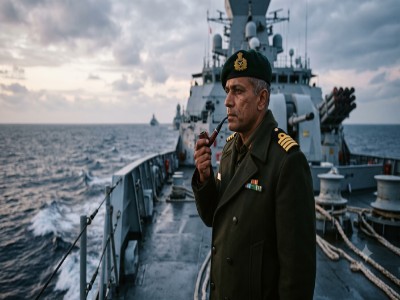
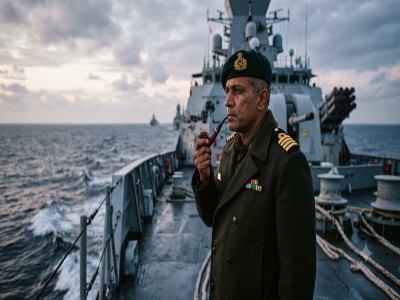
A survivor, Commodore S.N. Singh, later recalled the single most courageous image of that night: Captain Mulla standing on the bridge of the sinking Khukri, puffing quietly on a cigarette, as the Arabian Sea rose around him. There was no panic in his face. No desperation. Just a man doing what he had decided to do, with the same calm he had brought to every other moment of his career.
The ship went under. Mulla went with it.
His daughter Ameeta, speaking decades later, offered the most honest explanation anyone has given for why he made that choice. She did not say it was duty. She did not say it was tradition. She said: "Knowing him as I did, it was the only thing to do."
What He Left Behind
Captain Mahendra Nath Mulla was posthumously awarded the Maha Vir Chakra, India's second-highest gallantry award. The Captain M.N. Mulla Auditorium at Navy Nagar in Colaba, Mumbai carries his name. A hall at the Selection Centre South in Bangalore is named after him.
An auditorium at the Defence Services Staff College in Wellington also bears his name. At Diu, a memorial stands on a hillock facing the sea, housing a full-scale model of INS Khukri encased in glass, looking out at the water that swallowed it.
In 2024, a character based on Mulla appeared in the film Border 2, portrayed by Ahan Shetty, bringing his story to a new generation for the first time through cinema.INS Khukri remains the only warship India has lost in combat since independence, and Mahendra Nath Mulla remains the only Indian naval captain to have gone down with his vessel. These are not small distinctions. They are the kinds that define an institution's soul.
Every sailor who has served in the Indian Navy since 1971 has served in the shadow of what Mulla did on that December night. He did not die because he had no choice. He died because, having given away his last means of survival to someone else, going back to the bridge was simply the only thing left to do.
That is not heroism as most people understand it. It is something quieter, and far tougher.