New U.S. Territory - Trump's Wildest Map Yet Just Rattled Global Oil Markets
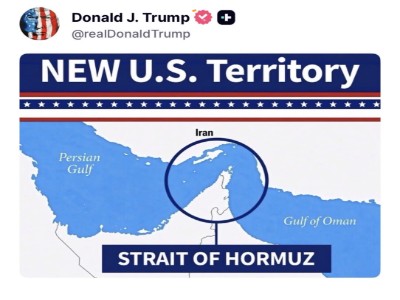
Imagine a sitting American president casually posting a map on social media, circling a strategic waterway that legally belongs to two other sovereign nations, and simply declaring it US territory. That's exactly what happened this week, and it's the latest, most bizarre chapter in a war that's dragged on far longer than anyone in Washington initially expected.
What Trump actually posted, and why it matters
On Tuesday, President Trump shared an image on Truth Social showing the Strait of Hormuz circled, with land along its shorelines in Oman, the UAE, and Iran, labelled simply "NEW U.S. TERRITORY," no explanation, no context. This wasn't a one-off outburst either. He'd first floated the idea days earlier at a campaign-style event on Long Island, telling the crowd he'd be declaring the waterway US territory "pretty soon," and reiterated it in the Oval Office on Monday, insisting "we control it with the blockade" and that he simply "liked the idea" of formalising that control on paper.
Here's the problem: the Strait of Hormuz isn't unclaimed territory sitting somewhere in international waters, it sits within the sovereign territorial waters of Iran and Oman, two countries with no legal connection whatsoever to the United States. Iran's response was blunt and dismissive. Deputy Foreign Minister Kazem Gharibabadi called the map a "delusion" on social media, insisting the strait "has been Iranian, is Iranian, and will remain Iranian," and warned that Iran's blockade would continue until that delusion was "corrected."
How things got here
This entire saga traces back to the US-Israel war on Iran that erupted in late February 2026. Iran responded by effectively shutting down the Strait of Hormuz, the waterway through which roughly a fifth of the world's oil and LNG normally flows. What followed was months of escalating brinkmanship: Trump issued repeated 48-hour ultimatums threatening to "obliterate" Iranian power plants, extended deadlines multiple times, and at one point suggested the US might charge tolls on ships passing through the strait, an idea maritime law experts and even his own officials reportedly warned would be illegal under international law.
A fragile memorandum of understanding between Washington and Tehran had briefly opened the door to renewed nuclear talks and a partial reopening of the strait. But that deal officially expired this past Monday, collapsing almost immediately after Iranian officials argued it granted them the right to control and restrict vessel traffic through the waterway, firing on ships that didn't comply. Fighting has continued in the weeks since, with three US service members killed in exchanges of fire.
Why the map, and why now?
The timing here isn't accidental. Trump is facing genuine political pressure at home, rising anti-war sentiment across America, unease even within his own party on Capitol Hill, and midterm elections just weeks away, all while a war he once promised would swiftly topple Iran's government instead appears stalled, with no deal in sight on Iran's nuclear programme. Analysts covering the story suggest the territorial claim looks less like a genuine policy proposal and more like an attempt to reframe a stalemate as a symbolic victory. It's also part of a broader pattern for this administration, Trump has previously floated annexing Canada as the "51st state," taking control of Greenland, and even alluded to controlling the Gaza Strip, none of which have moved beyond rhetoric.
Where the real tension is building: Oman
While the map grabbed headlines, the more consequential story might be happening quietly between Washington and Muscat. Oman has been acting as a mediator, negotiating directly with Iran on a plan to reopen safe shipping routes through the strait. Trump, frustrated that a longtime US strategic partner was inching toward a deal he didn't fully control, threatened in a Fox News interview to "bomb the s— out of" Oman if it "gets in the way" of US operations, a startling threat against a country that has hosted US naval access for years.
What this means for the world watching, including India
Shipping through the strait remains near a standstill, just three vessels transited on one recent day, according to ship-tracking data, and a similar blockade in the nearby Bab el-Mandeb Strait by Yemen's Houthis has compounded the disruption.
Analysts at Eurasia Group note that any recovery in Hormuz traffic will likely be partial and fragile at best. For countries like India that depend heavily on crude oil imports, this continued paralysis, layered now with a genuinely bizarre territorial claim that's further poisoned already-collapsed negotiations, means continued upward pressure on global energy prices remains a very real risk, regardless of how seriously anyone takes Trump's map.

_1200x675.jpeg)


Share Your Comments
Related Posts
Why Trump Called Mukesh Ambani's Reliance US Refinery Deal Historic...
Laandmark investment on American soil, Reliance and by extension, India has sent a clear message to Washington: we are serious partners, not just opportunists.
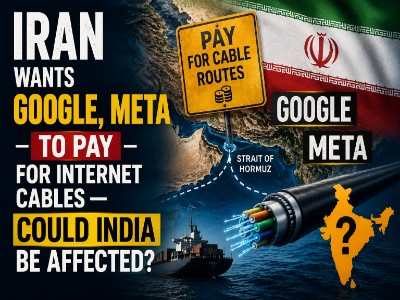
Iran Eyes Google, Meta Cable Fees — India May Feel the Impact...
An Iranian lawmaker, Mostafa Taheri, floated a figure of $15 billion annually as potential fee revenue from these 17 cables crossing the strait. On top of that, Iran has formally established a new body called the Persian Gulf Strait Authority
.jpeg)
Iran Proposes €50 Million Reward for Killing Trump...
The man behind this proposal is Ebrahim Azizi, Chairman of the National Security and Foreign Policy Committee of Iran's Parlia