No Army Still - How Small Nations Are Winning at Global Politics...
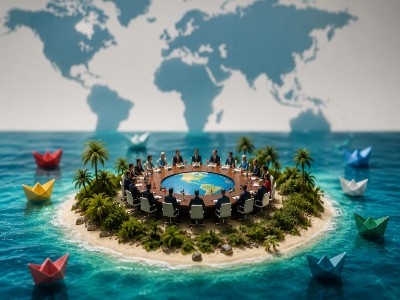
These nations have no standing army. Some have populations smaller than a Delhi neighbourhood. A few of them are so low-lying that a rise in sea levels could erase them from the map entirely within decades. And yet, some of the most powerful shifts in global policy over the last thirty years have been driven not by America, China, or Russia but by small island nations that most people cannot find on a map.
This is not an accident. It is strategy, and it is working beautifully.
The Underdog Playbook Nobody Expected
When people think of global power, they think of military strength, economic muscle, and nuclear arsenals. But international relations, particularly inside institutions like the United Nations, do not always work that way. Every member nation, regardless of size, wealth, or population gets one vote in the General Assembly. That single structural fact is the entire foundation on which small island nations have built extraordinary influence over decades.
हिंदी में पढ़ें: न सेना, न ताकतवर हथियार — दुनिया की राजनीति बदल रहे छोटे देश
Countries like Tuvalu, Fiji, Palau, Maldives, and Vanuatu figured out something pivotal long before bigger nations did, that moral authority, when deployed at the right moment on the right issue, can move mountains that military threats simply cannot. These nations entered global diplomacy not with weapons or wealth, but with something far harder to argue against the truth of their own lived reality.
Climate Change: Where Small Nations Changed the Entire Conversation
The single greatest example of small island influence on global policy is the climate crisis narrative. For years, large industrialised nations controlled the pace and direction of climate negotiations. They set the timelines, softened the targets, and kept the language of international agreements comfortably without taking the real accountability.
Then small island nations walked into those negotiating rooms and did something that changed everything, they made it personal, urgent, and impossible to ignore. Representatives from Tuvalu addressed the United Nations literally standing knee-deep in ocean water to illustrate what rising seas actually meant for their people. The Maldives held a full underwater cabinet meeting to send a message the world could not scroll past or dismiss as exaggeration.
These were not just dramatic gestures for television cameras. They fundamentally changed how the global media, the general public, and ultimately world leaders framed the climate conversation. The 1.5 degrees Celsius target now the central benchmark in every serious climate agreement including the landmark Paris Accord was pushed aggressively and relentlessly by small island nations under the Alliance of Small Island States, known as AOSIS. Larger, more powerful nations were comfortable settling for a 2 degrees target. Island nations flatly refused, arguing it was quite literally a matter of national survival, and they won that argument in front of the entire world.
The United Nations: A Room Where Size Does Not Decide Everything
Inside the UN General Assembly, small island nations have mastered the art of coalition politics. Individually, a nation like Nauru, with a population of barely fifteen thousand people carries limited weight in global conversations. But grouped together under AOSIS, which represents over forty island and low-lying coastal nations, they become a cohesive voting bloc that no major power can comfortably dismiss or sideline.
This is diplomacy at its best. Small nations strategically trade votes on issues that matter less to them in exchange for political support on issues that determine their very existence. They build long-term relationships with larger sympathetic nations, the European Union, Canada, New Zealand, and increasingly India to amplify their stands far beyond what their size would normally allow. They use every procedural tool available within international institutions to keep their issues firmly on the global agenda, even when powerful nations with competing economic interests would much prefer to move on quietly.
The Power of Narrative and Global Sympathy
Beyond votes and formal diplomacy, small island nations have mastered something even more powerful in the modern world storytelling. In this era where public opinion shapes foreign policy faster than ever before, the image of an entire nation disappearing beneath the ocean is not just a humanitarian concern. It is a story that travels across social media, into living rooms, and eventually into the consciousness of voters in powerful democracies who then pressure their own governments to act differently.
This soft power, built entirely on visibility and moral urgency, has proven remarkably durable. It keeps island nations relevant in conversations where they have no economic leverage and no military card to play.
Why This Matters for India
India sits in a uniquely important position in this discussion. As a major developing economy with deep historical, cultural, and geographic ties to island nations across the Indian Ocean and the Pacific, India has both a responsibility and a significant opportunity here. Supporting small island diplomacy is not an act of charity or sentimentality, it is smart, far-sighted foreign policy that builds genuine goodwill, strengthens multilateral institutions that India itself depends on, and positions the nation as a true global leader rather than simply a regional power with regional ambitions.
As climate negotiations grow more intense through the coming decade, the alliance between India and small island nations could become one of the most consequential partnerships in international diplomacy.
The world's smallest nations are teaching the biggest ones a lesson that no military budget can buy that survival, when communicated with absolute clarity and raw courage, remains the most compelling foreign policy argument the world has ever heard.




Share Your Comments
Related Posts
The 'H' Factor Between Journalism and Politics
Journalism and politics often appear to move side by side, journalism is far broader in scope.

Why sudden shifts in power have become the new norm In American politics...
White House. Political analysts typically focus on the president and his party's immediate decisions whenever voters turn against the party in power.
.jpeg)
Stalin vs Mamata: Two Different Faces of Politics...
Stalin said, “We accept the mandate.” Mamata said...