The 30 Lakh Crore Empire Just Lost Its Captain, And Nobody Knows Who's Next
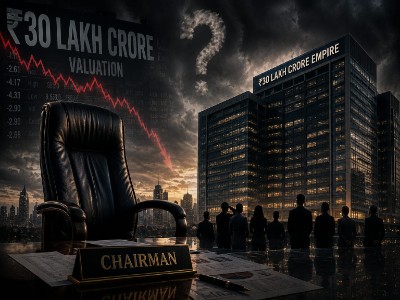
For nearly a decade, one man quietly steered India's most trusted business empire, salt to software, tea to steel, cars to airlines, through boardroom battles, a global pandemic, and the loss of its legendary patriarch. This week, that era came to an abrupt, tension-filled end. N Chandrasekaran, chairman of Tata Sons, has announced he won't seek another term, and the reasons behind his exit reveal a genuine power struggle brewing at the heart of India's most storied conglomerate.
What actually happened
Chandrasekaran, widely known simply as "Chandra," announced his resignation just days ahead of the Tata Group's annual general meeting scheduled for August 18. His current term technically runs until February 20, 2027, so this isn't an immediate departure, but it does definitively end months of uncertainty about whether he'd continue leading the group. The timing matters enormously, this announcement lands right before shareholders and investors gather for the AGM, guaranteeing the succession question will dominate the room.
Why did this actually happen?
Here's where the story gets genuinely dramatic. According to Chandrasekaran's own account, the two Tata Trusts, the Sir Dorabji Tata Trust and the Sir Ratan Tata Trust, which together hold majority control over Tata Sons, had unanimously recommended extending his tenure for another five years. That should have been a formality. Instead, when the proposal reached the Tata Sons board in February 2026, it hit a wall: a single board member withheld support, creating a deadlock that dragged on for six full months without resolution.
Reports have linked this impasse directly to friction with Noel Tata, half-brother of the late Ratan Tata, who took over as chairman of the Tata Trusts in 2024 following Ratan Tata's death. This points to a deeper structural tension that's been simmering beneath the surface of the Tata Group's genteel public image, differences over control, direction, and possibly the pace and style of the group's push into new-age, high-tech sectors like semiconductors, electric vehicles, and aviation.
Chandrasekaran, for his part, framed his decision partly around personal milestone, having completed 40 years with the Tata Group since joining in 1987, and asked the board to begin the succession process immediately to ensure a clean, proper transition rather than dragging the uncertainty out further.
Why this matters so much
To understand the stakes here, you need to appreciate what Chandrasekaran actually built during his near-decade at the helm. He took over in 2017 in the immediate aftermath of one of Indian corporate history's messiest boardroom battles, the very public ouster of his predecessor, Cyrus Mistry, which had left investors rattled and the group's governance reputation bruised. Chandrasekaran spent years steadying that ship, streamlining Tata's sprawling portfolio, and later spearheading the group's ambitious bets on semiconductors and electric vehicle manufacturing, positioning Tata as central to India's push into advanced technology manufacturing.
Losing that leadership right now carries real weight, not just symbolically but strategically. The Tata Group sits at the centre of several of India's most ambitious industrial pivots at precisely the moment those bets need steady, decisive direction. A leadership vacuum, or worse, a prolonged, contentious succession battle playing out in public again, risks unsettling investors and slowing momentum on projects that matter well beyond the Tata Group itself.
What happens now?
For the moment, Chandrasekaran remains in charge, this is a announced, planned exit rather than an immediate walkout, giving the board roughly a year and a half to identify and prepare a successor. But the honest truth is that finding consensus won't be simple, the same underlying disagreement that blocked his extension, whatever its exact nature, hasn't been resolved, it's simply been deferred. Whoever eventually takes the chair will need to win the confidence of both the Trusts and a board that clearly isn't unified right now.
Why should this matter to an ordinary reader?
The Tata Group isn't just another business house, it's a company whose products and services touch millions of ordinary Indian lives daily, from the salt in your kitchen to the car you might drive, the hotel you might stay at, or even the phone network or IT services powering the business you work for. Leadership uncertainty at this scale tends to ripple outward, affecting everything from stock prices of Tata group companies to investor confidence in India's broader corporate governance standards. As the countdown to next February begins, all eyes will be on how gracefully, or messily, one of India's most respected business empires manages to choose its next captain.
_1200x675.jpeg)

Share Your Comments
Related Posts

Chaos At The Border- Inside Spain's Biggest Migrant Crisis In Years
Nearly 60,000 migrants stormed Spain's Ceuta enclave from Morocco, leaving over 70 dead and sparking an EU-wide crisis.
_400x300.jpeg)
The Water Crisis Is Not a Future Problem — It’s a Present Disaster
Old agricultural land slowly turning into construction sites, and families who are neither fully rural nor truly urban