The Great Job Market Split- Why 90,000 Techies Lost Jobs While India Still Calls Itself A Talent Hub
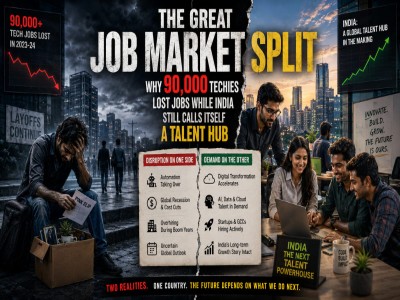
Two headlines from 2026 sound like they belong to completely different countries. One says over 90,000 tech employees lost their jobs globally in just the first four months of the year, with Oracle cutting nearly 12,000 roles in India in a single morning. The other says India's employability has climbed to a record 56.35 percent, and the country now commands 16 percent of the world's entire AI talent pool. Both are true, at the same time, and understanding why tells you almost everything about how careers actually work in India right now.
The layoffs are real, and they're not the usual kind
Let's start with the uncomfortable part. Nearly 30,000 tech roles were eliminated across 27 major companies in just the first 40 days of 2026 alone. Amazon cut thousands of corporate positions across Bengaluru, Chennai, and Hyderabad. TCS reduced its workforce by over 19,000 in a single quarter. Companies from Flipkart to Livspace to Accenture followed with cuts of their own. Fresh graduates have been hit particularly hard, entry-level IT hiring reportedly fell as much as 80 percent from its peak, and worryingly, a growing number of candidates are stuck in limbo, holding offer letters but with joining dates indefinitely deferred, a pattern that's become a genuine source of distress for young job seekers across the sector.
Here's the part that matters most: this isn't the layoff cycle India has seen before. The 2022 and 2023 job cuts were largely corrections after companies overhired during the pandemic boom, a clear beginning, a clear end. This time is structurally different. According to India's own Economic Survey 2025-26, AI adoption and automation are the primary drivers behind this year's workforce reductions, not a temporary demand slowdown. Companies are quietly restructuring around leaner teams built on specialised capability rather than broad headcount, and many are simply calling it "restructuring" rather than openly acknowledging that AI has displaced the roles directly.
So why is India still being called a rising talent hub?
Because the same forces cutting jobs in one corner of the market are creating genuine opportunity in another. The India Skills Report 2026, drawing on responses from over 100,000 candidates, found employability has risen consistently from 46.2 percent in 2022 to 56.3 percent now, with technology, BFSI, manufacturing, renewable energy, and healthcare leading hiring demand. Global Capability Centres, the India-based offices of multinationals like Google, Amazon, Microsoft, and JP Morgan, are expected to add somewhere between 1.2 to 1.4 lakh net new roles in 2026, comfortably outpacing the layoffs happening elsewhere in the sector. These GCC roles tend to be better-paid and more technically demanding too, though they're also considerably less accessible to freshers who lack specialised AI, cloud, or data skills.
Meanwhile, India's gig and freelance workforce keeps expanding rapidly, projected to hit 23.5 million workers by 2030, and project-based hiring, where companies evaluate real proof-of-work rather than degrees alone, has grown 38 percent over the past year.
What separates the people getting hired from the people getting laid off
The pattern here is genuinely consistent across every report: skills, not tenure or job titles, decide who survives this shift. AI and machine learning, cloud architecture on platforms like AWS and Azure, cybersecurity, and data science are the areas companies are actively hiring for even while cutting generalist roles elsewhere. One striking statistic captures the anxiety this has created: 84 percent of Indian professionals admit they feel unprepared to find a new job if they suddenly needed to.
The professionals who are prepared tend to share one thing in common, demonstrated, tangible work rather than just credentials. A handful of solid, real projects on a portfolio genuinely carries more weight with employers now than a stack of course-completion certificates. Career experts have started pointing out something worth remembering too: while AI has become genuinely good at writing code and analysing data, it still can't replace communication, the ability to build trust, present ideas clearly, and lead a room, skills that are becoming a stronger differentiator precisely because so much routine technical work is being automated.
What this actually means if you're building a career right now
The honest message from 2026's job market isn't "opportunities are disappearing," it's that comfort and stability, get hired, coast on the job title, wait for annual raises, has quietly stopped being a reliable strategy. Continuous upskilling has shifted from being a nice-to-have career advantage to something closer to basic professional survival. Whether you're a fresh graduate trying to land your first role or a mid-career professional watching your industry get restructured around you, the underlying advice from every single report points the same direction: build real, visible proof of what you can actually do, and keep learning skills that AI genuinely struggles to replace, particularly the human ones.



Share Your Comments
Related Posts
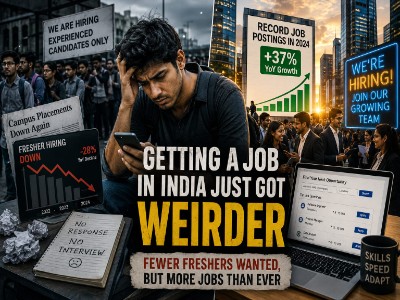
Getting A Job In India Just Got Weirder- Fewer Freshers Wanted, But More Jobs Than Ever
Why India's job market is growing overall even as entry-level opportunities shrink, and what skills-first hiring means for freshers.

Same Win, Different Headline: How Western Media Frames India’s Success...
When India's Mangalyaan probe successfully entered Mars orbit in 2014

So What If It's "Propaganda"? Maybe India Just Deserves To See Itself Win For Once
Why calling patriotic Bollywood hits like Dhurandhar "propaganda" ignores the double standard in how India's wins versus struggles get judged on screen.