The 'H' Factor Between Journalism and Politics
The relationship between journalism and politics has always been one of the defining debates of any democracy. Journalism exists to question those in power and bring the truth to the public. Politics, on the other hand, is driven by the pursuit and preservation of power.
By Dharmendra Kumar
Although journalism and politics often appear to move side by side, journalism is far broader in scope. In newsrooms, politics is merely one reporting beat among many. Yet in countries like India where politics dominates public discourse, it inevitably exerts a powerful influence on journalism itself.
हिंदी में पढ़ें: पत्रकारिता और राजनीति में ‘एच’ का पेंच
These are two distinct streams flowing in different directions, yet they frequently meet at the same point. Journalism speaks the language of questions; politics speaks the language of power. Sometimes their interaction strengthens democracy, and sometimes it weakens it.
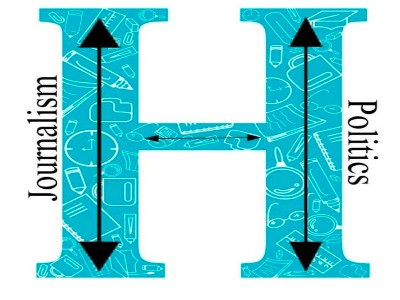
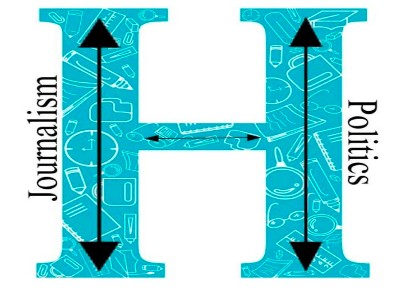
The English letter "H" offers a metaphor for this relationship. The two vertical lines represent journalism and politics—standing independently of each other. The horizontal bar connecting them symbolizes the bridge between the two professions. That bridge often allows journalists to enter politics, while politicians increasingly adopt the style and platforms of journalism to shape public opinion.
However, the bridge is rarely a two-way street. Many journalists successfully transition into politics, but once they become political figures, returning to journalism as credible and impartial observers becomes extraordinarily difficult.
This phenomenon is not unique to one country. In the United States, several television journalists and news anchors have entered politics, with some eventually serving in Congress or the Senate. Yet American media culture generally emphasizes maintaining a clear institutional separation between journalism and political office. Across much of Europe, journalists entering politics remains comparatively uncommon, reflecting a stronger tradition of preserving journalistic independence. In many emerging democracies, however, politics often exerts a far greater influence over the media ecosystem.
History illustrates both the value and the vulnerability of this relationship. During many national independence movements, journalism played a vital role in mobilizing public opinion and amplifying political voices. Conversely, periods of authoritarian rule have often witnessed censorship and attempts to silence the press. Today, in the digital age, the bridge between journalism and politics has become busier than ever. Journalists join political parties, while political leaders use media platforms and direct communication channels to present themselves as commentators, analysts, or even journalists.
In recent years, numerous journalists have entered politics. Some have enjoyed successful political careers; others have not. But once a journalist becomes an active political participant, their greatest professional asset—public trust in their independence—inevitably comes under scrutiny.
The public begins to ask an important question: Can a former politician truly return as an independent journalist, or will their journalism become an extension of their political identity? If the movement between journalism and politics becomes routine, the credibility of journalism itself risks being eroded. Politics may benefit from this exchange, but journalism often bears the greater cost.
The "H" connecting journalism and politics is far more than a visual metaphor. It represents an enduring democratic dilemma: how to preserve the independence of those who hold power accountable while acknowledging the inevitable intersections between media and political life.
For democracy to remain healthy, journalism must safeguard its integrity and maintain a clear distance from political power. Otherwise, the bridge connecting the two may eventually cause journalism to lose itself in the crowd of politics.
This version is adapted for an international audience, using globally relevant examples and neutral language while preserving the central metaphor and argument of the original article.

Share Your Comments
Related Posts

UAE Did It - Will India do it for its future...
The decision makes the UAE the first Arab nation to introduce such ban
_400x300_(1).jpeg)
Pakistan Is Happier Than India?
Do you really want to believe that a country facing civil unrest ranks higher than India on an international media or governance index?
No Army Still - How Small Nations Are Winning at Global Politics...
Small nations strategically trade votes on issues that matter less to them in exchange for political support on issues that determine their very existence.