How to incorporate a company in India...

The incorporation of a company marks the formal birth of a separate legal entity endowed with perpetual succession and limited liability.
Written by CS Deepak Sharma
(Company Secretary, LL.B & M.Com)
(M.) +9873 99 7776, Email: csdeepaksharma10@gmail.com
New Delhi, Published by Deepak, 7 November 2025, Friday, 3:46 PM IST
The Companies Act, 2013, and the Companies (Incorporation) Rules, 2014, govern the procedure for the formation and registration of companies in India.
1. With the introduction of the SPICe+ (Simplified Proforma for Incorporating Company Electronically Plus) system, the Ministry of Corporate Affairs (“MCA”) has streamlined the incorporation process by integrating multiple services—ranging from name reservation to PAN, TAN, EPFO, ESI, and GST registration—into a single web form.
However, before approaching the Registrar of Companies (“ROC”) with the incorporation application, promoters must undertake several critical preparatory steps, each carrying procedural and legal significance. These preparatory actions are discussed below.
2. Preparation of Class III Digital Signature Certificate (“DSC”)
The execution of electronic documents and e-filing on the MCA portal necessitates the use of a Class III Digital Signature Certificate. In terms of Section 4 of the Information Technology Act, 2000, a document bearing a valid digital signature has the same legal recognition as a manually signed document.
Each proposed director and subscriber to the Memorandum of Association (“MOA”) must obtain a valid Class III DSC from a licensed Certifying Authority such as eMudhra, Sify, SignX, or Capricorn.
Essential requirements:
• Self-attested copies of PAN, Aadhaar, a recent photograph, email address, and Mobile number (with country code);
• Verification through video KYC, email, and mobile OTP verification, as per the Certifying Authority’s process;
• Validity generally of one or two years, renewable thereafter.
The DSC is thereafter used for digitally signing the SPICe+, MOA (INC-33), AOA (INC-34), and ancillary e-forms.
3. Name Reservation
Under Section 4(2) & (3) of the Companies Act, 2013 and Rule 8 of the Companies (Incorporation) Rules, 2014, the name of a company shall not be identical with, or resemble too nearly, the name of an existing company, LLP, or registered trademark.
Promoters may apply for name reservation through:
• For a new Company - Part A of SPICe+ Form, or
• For the existing Company - RUN (Reserve Unique Name) service on the MCA portal.
Key considerations:
• Conduct preliminary searches on the MCA and trademark databases through their websites.
• Avoid generic words and expressions prohibited under the Emblems and Names (Prevention of Improper Use) Act, 1950;
• Indicate the main objects' activity codes of the company to justify the name. The activity codes for the various categories are available on the National Classification Code (“NIC”) list 2008.
• On approval, the name remains reserved for 20 days for new companies, which can be extended up to 60 days with an additional fee.
4. Subscribers to the Memorandum of Association
Post reservation of the desired name, the next step is to identify the subscribers and their shareholding ratios.
Every company must have at least two subscribers in the case of a private company and seven in the case of a public company (Section 3 of the Companies Act, 2013).
Subscribers signify their consent to take shares and become members of the company by digitally signing the Memorandum of Association (INC-33) and the Articles of Association (INC-34).
Key points:
• Each subscriber must subscribe to at least one share.
• The details of subscribers, including name, father's name, address, occupation, photograph, and number of shares taken, are mentioned in the subscription clause of the MOA;
• The above particulars can be given through certain declarations,
• Where a body corporate is a subscriber, the resolution authorizing its representative must be attached.
5. First Directors
The first directors are those named in the Articles of Association or, in their absence, the subscribers to the memorandum are deemed to be the first directors until directors are duly appointed.
Statutory provisions:
• At least one director must be resident in India, as per Section 149(3) (i.e., residing for not less than 182 days during the preceding financial year).
• Each proposed director must obtain or be allotted a Director Identification Number (“DIN”) and furnish a few declarations, including consent to act as director (Form DIR-2), interest in the other entities, etc.
• Details of the first directors are furnished in the Form SPICe+. There is no requirement to file a separate form DIR-12.
6. Fixing the Capital Structure of the Company (Authorised and Paid-up Share Capital)
The Authorised Share Capital represents the maximum amount of capital the company is permitted to issue, while the Paid-up Capital denotes the amount actually subscribed and paid by shareholders.
Though the erstwhile minimum capital requirements were abolished by the Companies (Amendment) Act, 2015, promoters must prudently decide capital structure based on the scale of operations, funding needs, and regulatory thresholds.
Practical approach:
• Fix the authorised capital marginally higher than the initial paid-up capital to accommodate future allotments to the shareholders. The future allotments can be done through Private placement or Preferential allotments.
• Along with the determination of the capital structure of the Company, the denomination of the per share value needs to be fixed, e.g., Re.. 1 per Equity Share, Rs. 10 per share or Rs. 100 per share, etc.
• Note that ROC filing fees are linked to the authorised capital of the Company.
• Appropriately reflect the shareholding pattern in the MOA (Table A of Schedule I).
7. Registered Office, Coordinates, and Communication Details
Pursuant to Section 12(1) of the Companies Act, 2013, a company must have a registered office capable of receiving communications and notices from the ROC from the date of incorporation.
Documentation:
• Proof of address (Conveyance Deed or Lease deed/rent agreement, if premises are rented or other ownership document) and a recent utility bill (not older than two months);
• No-Objection Certificate (“NOC”) from the owner/lessor;
• Declaration of the email ID and contact number of the company in the incorporation form.
• Coordinates (Latitude and Longitude) of the registered office premises.
If the registered office was not finalised at the time of incorporation of the Company, it will be finalised in the next 30 days from the date of incorporation with the following additional information/documents.
• In addition to the above documents, a picture of the registered office premises from inside and outside (with one director present).
8. Selection of Bank
Opening a bank account in the name of the company is a post-incorporation yet strategically important decision. Certain banks, in collaboration with the MCA, offer seamless account opening concurrent with incorporation under the SPICe+ facility.
Promoters should select a bank offering efficient digital corporate services, net-banking facilities, and smooth integration for statutory payments (EPFO, GST, MCA). The bank account name must exactly match the name stated on the Certificate of Incorporation.
Conclusion
The incorporation of a company is both a legal and strategic exercise, laying the foundation of a distinct juridical entity. The preparatory steps—ranging from procurement of digital signatures to appointment of first directors—require precision and adherence to statutory formalities.
Professionals such as Company Secretaries play a pivotal role in guiding promoters through these steps, certifications of various forms, ensuring full compliance with the letter and spirit of the Companies Act, 2013. A meticulously executed incorporation process not only ensures legal validity but also instills governance discipline from the very inception of the corporate entity.
Disclaimer: This article is intended solely for general educational and informational purposes. It does not constitute legal advice or professional opinion. Readers are advised to consult a qualified professional or refer to the latest applicable laws and regulations before acting on any information contained herein. The provisions and interpretations may vary with subsequent amendments or judicial pronouncements.
For further clarification queries regarding setting up any business entities, you may contact:
CS Deepak Sharma
(Company Secretary, LL.B & M.Com)
(M.) +9873 99 7776, Email: csdeepaksharma10@gmail.com
_1200x675.jpeg)


Share Your Comments
Related Posts
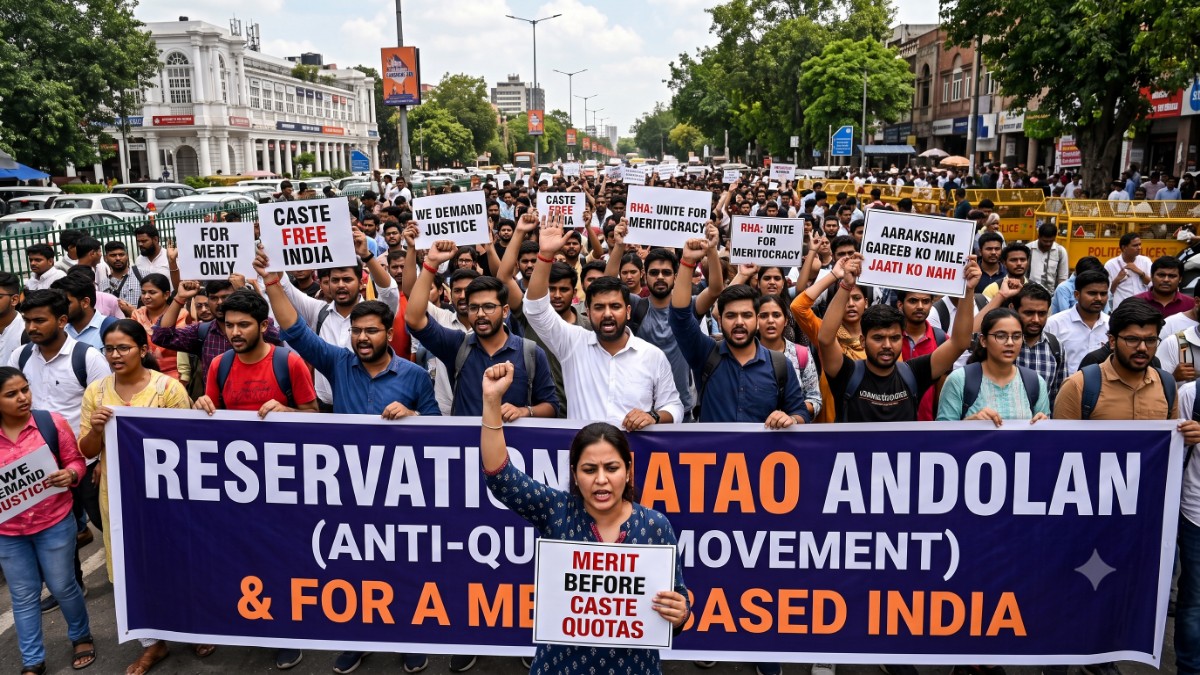
Reservation Hatao Andolan: Why India's Anti-Quota Movement Is Exploding
What started as an online campaign quickly evolved into physical demonstrations in Nagpur, Lucknow, Jaipur..

The Great Job Market Split- 90,000 Tech Jobs Lost: Is India Still a Talent Hub?
Why India saw 90,000 tech layoffs and record employability at the same time, and what it means for your career.

Getting A Job In India Just Got Weirder- Fewer Freshers Wanted, But More Jobs Than Ever
Why India's job market is growing overall even as entry-level opportunities shrink, and what skills-first hiring means for freshers.