India Is Borrowing to Live, and Nobody Is Talking About It Loudly Enough
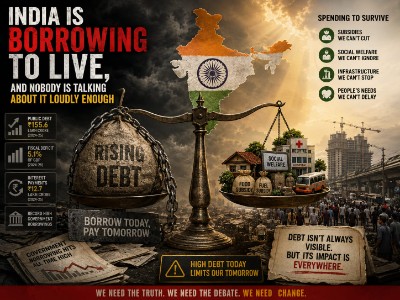
The Sensex rose 600 points this morning. GDP is growing at 7.4 percent. India is the world's fastest-growing major economy for the fourth consecutive year. Every financial headline you read this week will confirm some version of this optimism.
And quietly, buried in an RBI report released in December 2025, is a number that deserves to sit next to every one of those celebratory headlines: India's household debt has risen to 41.3 percent of GDP, above its five-year average, led primarily by consumption-oriented retail loans. Meaning millions of Indians are not spending from income. They are spending from borrowed money. And the gap between the economy's headline performance and the financial health of the households inside it is widening in ways that the GDP number alone cannot capture.
What 41.3 Percent Actually Means
Household debt as a percentage of GDP is one of the most honest measures of whether an economy's growth is sustainable or borrowed. When households take on debt to invest, to build homes, or to fund education that will generate future income, that debt is productive. When households take on debt to pay for groceries, school fees, medical bills, and daily consumption because their income isn't keeping up with their expenses, that debt is a warning signal.
India's household debt rose to 41.3 percent of GDP at end-March 2025, led by consumption-oriented retail loans, even as net financial savings improved in Q4 FY25. The category driving this rise is not home loans or business investment. It is personal loans, credit card debt, buy-now-pay-later schemes, and consumer durables financing. People borrowing to buy phones, furniture, appliances, and in many cases simply to manage monthly cash flow shortfalls.
Compare this to China, where household debt stands at approximately 63 percent of GDP, or South Korea at over 100 percent, and 41.3 percent might seem manageable. But the rate of increase matters as much as the absolute level. India's household debt has risen sharply over the past five years, precisely the same five years during which real wage growth was negligible and inflation consistently outpaced income gains for salaried workers.
The EMI Economy and What It Hides
Walk into any electronics store in any Indian city today and the conversation about price has largely been replaced by a conversation about EMI. Zero-cost EMI. No-cost EMI. Three months, six months, twelve months. The product's actual price has become almost secondary to whether the monthly instalment fits into a budget that is already stretched thin.
This is not a uniquely Indian phenomenon. Consumer credit has expanded globally as financial inclusion has deepened. But in India's case, the expansion of consumer credit has coincided with a specific economic squeeze that makes the combination more fragile than the headline numbers suggest. Over 5.4 lakh first income tax appeals remain pending, reflecting the broader administrative strain on India's financial system, while 65 percent of total household expenditure is consumed by essential expenses like food, rent, education, and healthcare, leaving almost nothing for discretionary spending or savings.
When 65 percent of income goes to essentials, and essentials keep getting more expensive, the mathematical solution that millions of households have found is credit. The EMI economy is not a sign of financial confidence. It is, in many cases, a sign of financial stress being managed through deferral.
The Tax Base That Tells the Full Story
Here is the detail that should concern policymakers more than any single debt figure. India's income tax return filings have grown significantly, with over 5 crore returns filed in the current assessment year, an 8 percent increase from the previous year. More Indians paying taxes sounds like good news, and it is, partly.
But the distribution of that tax burden reveals a structural problem. India's formal salaried class, which already contributes disproportionately to income tax collections, is also the same demographic absorbing the highest levels of consumer debt. These are the people whose employers deduct tax at source before the salary arrives, who pay GST on everything they consume, who carry home loan EMIs, car loan EMIs, and now personal loan EMIs simultaneously, and whose real purchasing power has been compressed by five consecutive years of inflation running ahead of wage growth.
India's direct benefit transfers have reached over 58 crore beneficiaries at the bottom of the income pyramid. The welfare architecture is working. What is not working as well is the economic environment for the tier immediately above that, the formal middle class that earns too much to qualify for welfare but too little to comfortably absorb the compounding costs of modern Indian life.
What the RBI Is Watching
The RBI has not sounded an alarm. The 41.3 percent figure was noted in a report without accompanying crisis language, and India's household debt levels remain significantly below those of developed economies. The central bank's concern is calibrated: watch the rate of increase, monitor the quality of the underlying loans, and ensure that the personal loan boom driven by fintech lenders is not creating unseen pockets of distress.
What the RBI is watching carefully, and what deserves more public conversation than it is currently receiving, is the asset-liability mismatch at the household level. Households are borrowing short-term, high-interest consumer credit to fund long-duration needs. A medical emergency paid for on a credit card at 36 percent annual interest is not a financial product. It is a debt trap with good branding.
The Question the GDP Number Cannot Answer
India's 7.4 percent GDP growth is real. The infrastructure being built is real. The digital economy's scale is real. None of this is manufactured.
But GDP measures the total output of an economy, not the distribution of wellbeing within it. An economy where growth is being partly funded by household debt accumulation is an economy where some of today's consumption is being borrowed from tomorrow's income. That is sustainable up to a point. The question worth asking, loudly and honestly, is whether India is approaching that point, and whether the people making economic policy are watching the household debt curve as carefully as they are watching the GDP curve.
The Sensex will close higher today. Somewhere, a family will take a personal loan to pay a hospital bill. Both things are true simultaneously. Only one of them is making the headlines.

Share Your Comments
Related Posts
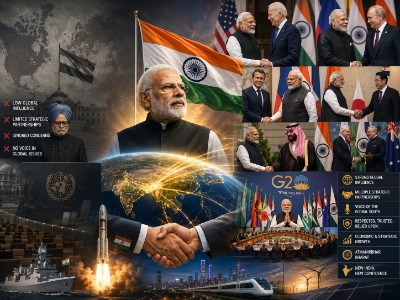
The World Stopped Ignoring India- Foreign Policy After 2014
From a country that waited to be invited to one that sets the global agenda, here is how India rewrote its place in the world after 2014.
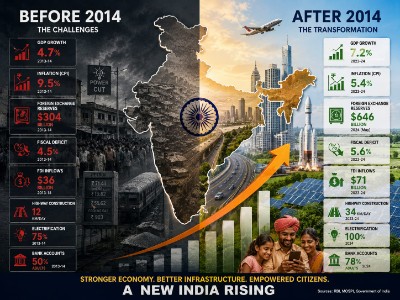
India Before and After 2014...
From Fragile Five to the world's fastest-growing economy, here is what twelve years of transformation actually look like in numbers.
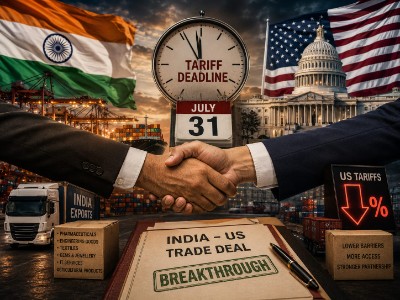
The Deal That Could Change Everything India Exports
The clock ran out, the tariffs arrived, and India still won't sign a bad deal, here's what the collapsed July 24 deadline actually means for your economy.