The World Stopped Ignoring India- Foreign Policy After 2014
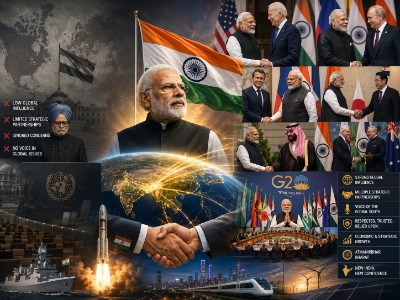
In 2014, India's foreign policy was politely described by analysts as reactive. The country participated in global forums, maintained traditional alliances, and navigated its neighborhood carefully, but rarely set the agenda. Twelve years later, G20 summits happen in New Delhi. World leaders queue for bilateral meetings. Prime Minister Modi has received 19 civilian honours from foreign governments, more than any other sitting head of state. India mediates between Russia and Ukraine. India chairs global conversations on digital public infrastructure. The country that once waited to be invited is now the one issuing the invitations.
What changed was not just the government. It was the entire posture.
The Neighbourhood First That Actually Meant Something
The first signal of a different foreign policy came on May 26, 2014, inauguration day, when every head of state from SAARC nations was invited to New Delhi for the swearing-in ceremony. It was a gesture unprecedented in Indian political history, a deliberate statement that the neighbourhood would be treated as a priority rather than an afterthought.
The Neighbourhood First policy translated into concrete infrastructure investments, connectivity projects, and development partnerships across Bangladesh, Sri Lanka, Bhutan, Nepal, and the Maldives, with India positioning itself as the preferred development partner for its immediate neighbors against a backdrop of Chinese infrastructure diplomacy expanding aggressively across South Asia.
The results were not uniformly successful. Nepal's political complexity, Sri Lanka's debt crisis, and the Maldives' periodic democratic turbulence all presented challenges that Neighbourhood First could not fully resolve. But the framework established India as a proactive regional player rather than a passive observer of its own backyard, which was itself a meaningful shift from the previous decade.
The Pakistan De-Hyphenation That Redefined South Asian Diplomacy
Perhaps the single most consequential strategic achievement of the past twelve years has been the permanent de-hyphenation of India and Pakistan in global diplomatic discourse, freeing New Delhi to focus on the real long-term strategic challenge, which is China, without every bilateral conversation being filtered through the India-Pakistan lens that had dominated Western and global engagement with South Asia for decades.
India's response to cross-border terrorism evolved from diplomatic protest to direct action. The Uri surgical strike in 2016, the Balakot air strike in 2019, and Operation Sindoor in 2025 collectively established what the government described as a new normal in India's security posture, signaling that cross-border terrorism would attract a military response rather than only a diplomatic one.
The international community's reaction to each of these actions was telling: where previous Indian governments had feared that military responses would invite international censure, the post-2014 government found that India's economic weight and strategic importance meant most major powers responded with restraint rather than condemnation.
The China Clarity That Nobody Wanted to State
India's relationship with China represents the most complex and consequential diplomatic challenge of the past twelve years, and the post-2014 government's handling of it reveals both the limits and the genuine achievements of the new foreign policy.
As early as 2014, India stood alone in challenging Xi Jinping's Belt and Road Initiative, refusing to endorse a project that ran through Pakistan-Occupied Kashmir and that India correctly identified as a strategic encirclement exercise rather than a genuine development programme. This was not a popular position internationally when it was taken. It became significantly more mainstream as BRI's debt trap dimensions became visible across Sri Lanka, Zambia, and multiple other recipient countries.
After the Galwan Valley clash of 2020, in which 20 Indian soldiers died in hand-to-hand combat with Chinese troops, India took an audacious diplomatic stand that it has not reversed: Sino-Indian relations cannot normalise unless the border situation is resolved. That clarity, maintained under sustained pressure from business lobbies and some diplomatic voices, represents a significant departure from the strategic ambiguity that had previously characterised India's China posture.
The Multi-Alignment That Became India's Signature
The most globally recognised innovation of India's post-2014 foreign policy is what analysts now call multi-alignment, the deliberate construction of deep relationships with multiple major powers simultaneously without exclusive alignment with any single bloc.
India maintained strong ties with Russia throughout the Ukraine conflict, buying discounted Russian oil that helped manage domestic inflation, while simultaneously deepening its strategic partnership with the United States through Quad participation, semiconductor agreements, and a $4 billion advanced drone technology deal. Critics called this contradictory. Practitioners called it strategic autonomy in the modern multipolar context.
India drew more than Rs 70 lakh crore in Foreign Direct Investment between 2014 and 2025, reflecting heightened foreign investor trust in an economy whose foreign policy stability made it a predictable and reliable partner for long-term capital commitments. The connection between foreign policy credibility and investment attraction is not automatic, but in India's case the correlation is visible in the numbers.
The Soft Power That Travelled Furthest
The promotion of yoga, Ayurveda, and Indian cultural heritage as diplomatic instruments produced the UN declaring June 21 as International Yoga Day in 2015, with 177 co-sponsoring nations, the largest number of co-sponsors for a UN General Assembly resolution at that time. The Vaccine Maitri initiative during COVID-19, which provided vaccines to over 90 countries, positioned India as a global healthcare partner rather than merely a recipient of international aid.
By 2026, India's UPI system had been adopted by UAE, Sri Lanka, Mauritius, Singapore, France, Bhutan, and Nepal, with 24 countries signing digital public infrastructure cooperation agreements, making India an exporter of governance architecture to the developing world and a model that international institutions including the IMF and World Bank now actively study and recommend.
The G20 Presidency of 2023, which India hosted in New Delhi, represented the clearest demonstration of this accumulated soft power. India shaped the agenda around Global South priorities, secured consensus on debt restructuring for developing nations, and delivered a summit that was widely assessed as the most substantive G20 in years. The African Union's admission as a permanent G20 member happened under India's presidency, a diplomatic achievement with long-term consequences for global governance architecture.
The Honest Accounting
Twelve years of Indian foreign policy produced genuine achievements: a new security posture toward Pakistan, clarity on China, multi-alignment as a credible global strategy, soft power that travels, and a seat at tables India previously watched from outside.
It also left genuine gaps. The neighbourhood remains volatile. China's border aggression has not been fully resolved. The Russia relationship carries reputational costs in Europe and with Ukraine. And India's permanent seat on the UN Security Council, the ultimate validation of great power status, remains aspirational.
But the distance between India's global standing in 2014 and its global standing in 2026 is not a matter of narrative. It is a matter of record. The world's most powerful leaders come to India now. They compete for India's partnership. They adopt India's technology. They study India's governance models.
That is what a foreign policy transformation looks like when it actually works.

Share Your Comments
Related Posts
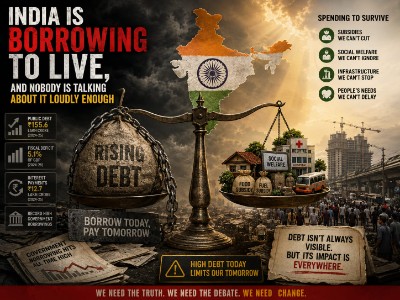
India Is Borrowing to Live, and Nobody Is Talking About It Loudly Enough
India's economy is growing at 7.4 percent, but its households are borrowing to keep up, here's the debt story hiding behind the headline numbers.
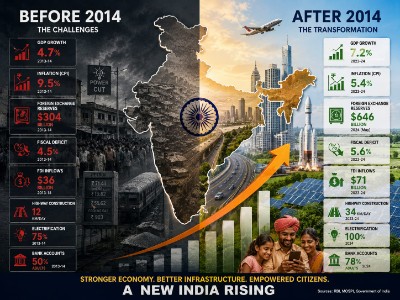
India Before and After 2014...
From Fragile Five to the world's fastest-growing economy, here is what twelve years of transformation actually look like in numbers.
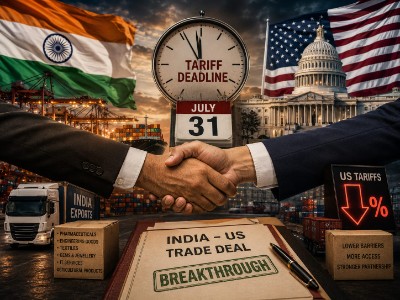
The Deal That Could Change Everything India Exports
The clock ran out, the tariffs arrived, and India still won't sign a bad deal, here's what the collapsed July 24 deadline actually means for your economy.