Why Trump Called Mukesh Ambani's Reliance US Refinery Deal Historic...
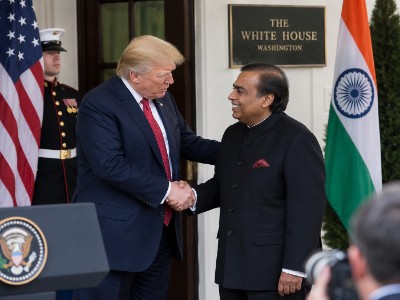
There are business deals, and then there are deals that quietly shift the balance of global power. What Mukesh Ambani's Reliance Industries just did in the United States falls firmly in the second category and most Indians haven't fully grasped how big this actually is. On March 10, 2026, US President Donald Trump announced that America is building its first new oil refinery in nearly 50 years and the anchor investor behind it is none other than India's Reliance Industries.
Written and published by Deepak Sriram, Delhi, 28 May 2026, Thursday, 4:30 AM IST
The location? Brownsville, Texas a deep-water port right at the US-Mexico border. The number being thrown around? A staggering $300 billion.
Now before your jaw drops too far, here's what that number actually means. The $300 billion is not the construction cost of the refinery. It is the total estimated value of a 20-year offtake agreement meaning Reliance has committed to buying the refinery's output over two decades. To break it down further: the deal is projected to involve purchasing and processing 1.2 billion barrels of US shale oil worth around $125 billion, and producing 50 billion gallons of refined products worth $175 billion combined, improving the US trade balance by $300 billion. Still a jaw-dropping number.
So why did Reliance do this? The answer lies in something much deeper than just business.
India and the United States have been growing closer strategically for years, but there's always been a trust deficit largely because India has historically walked the tightrope between the US and Russia, especially when it comes to buying discounted Russian oil. Trump, who has made "America First" his religion, was not exactly thrilled about that. By making this landmark investment on American soil, Reliance and by extension, India has sent a clear message to Washington: we are serious partners, not just opportunists.
Trump himself couldn't hold back his excitement, calling it "THE BIGGEST IN US HISTORY" and personally thanking India and Reliance for the "tremendous investment," crediting his own policies of streamlined permits and lower taxes for attracting the deal. When an American president publicly praises an Indian company at this scale, it carries enormous diplomatic weight. The refinery is being developed by America First Refining (AFR), and groundbreaking is expected in the second quarter of 2026. Industry analysts estimate the capital expenditure to be roughly $4–5 billion. The facility will be built in three phases, with Phase 1 expected to be operational by 2027, processing around 50,000–55,000 barrels per day. Full capacity across all three phases will reach approximately 164,000 barrels per day.
From a geopolitical lens, the timing couldn't be more calculated. Global oil prices have been volatile, hitting nearly $120 per barrel recently amid the escalating Middle East conflict. In such a climate, locking in a long-term supply agreement with an American refinery gives Reliance stable, predictable access to US shale oil reducing its dependence on Middle Eastern crude that can go haywire any time tensions flare. For India as a nation, this investment is also a soft power win of the highest order. At a time when countries are competing to show they're valuable allies to the US, India just placed one of the biggest chips on the table. This move strengthens India's negotiating hand whether it's about trade tariffs, technology transfers, defence partnerships, or even getting a better seat at global forums.
The refinery will produce some of the cleanest gasoline, diesel, and jet fuel refined at scale in the US, and will leverage advanced infrastructure with strategic rail and sea connections for distribution to both domestic and international markets. Thousands of American jobs will be created and that matters to Trump politically, which means India earns goodwill not just in the White House, but across American public opinion.
Reliance already operates the world's largest oil refinery in Jamnagar, Gujarat. Adding a strategic stake in American refining infrastructure means Ambani is now operating on both sides of the globe, a rare feat for any company, let alone an Indian one.
This isn't just an energy deal. It's India planting its flag in America's backyard confidently, strategically, and at exactly the right moment in history.



Share Your Comments
Related Posts
_400x300_(1).jpeg)
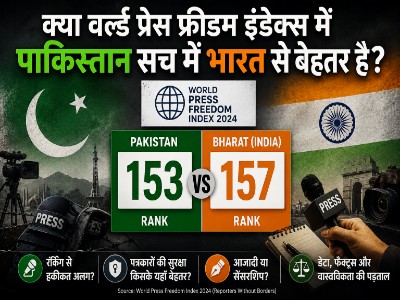
Pakistan Is Happier Than India?
Do you really want to believe that a country facing civil unrest ranks higher than India on an international media or governance index?

India and Canada Launch Trade Forum — Economic Chapter of mutual Benefits...
The timing is crucial. India and Canada went through a serious diplomatic falling out in 2023, which had nearly finished bilateral trade progress. But the political winds shifted when Canadian Prime Minister Mark Carney took office and visited India in March 2026.
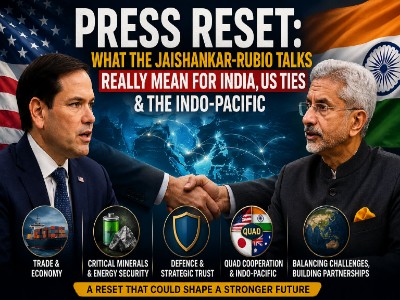
India and the US Press Reset- What the Jaishankar-Rubio Talks Really Mean for India...
The biggest takeaway for the average Indian, whether a business owner, a student planning to go abroad, or a professional in the IT sector is the trade deal. Marco said at the joint press conference that the pending India-US trade deal is on the "verge" of happening