Is opposition really scared of FCRA bill 2.0?
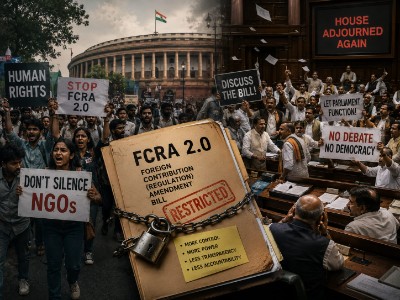
Ask about FCRA 2.0 to the opposition leaders who flew in for the cameras at Jantar Mantar. Some of them will change the subject. And yet, sitting quietly inside the Monsoon Session of Parliament, listed for consideration and passage alongside everything else the government wants to move this session, is a bill that may explain more about why certain people want Parliament disrupted than any exam paper ever could.
This is not a conspiracy theory. It is a question of timing, money, and who loses what if a particular law passes.
What FCRA 2.0 Actually Does
The Foreign Contribution Regulation Amendment Bill 2026, introduced in the Lok Sabha on 25 March 2026 and listed for consideration and passage in the ongoing Monsoon Session, is the most significant revision to India's foreign funding regulatory framework since the FCRA was overhauled in 2020.
The headline provision is this: the Bill creates a Designated Authority, notified by the central government, which will take provisional control of foreign contributions and assets in cases of cancellation, surrender, or cessation of FCRA registration. This control extends even to assets that are only partly funded through foreign contributions. The authority is empowered to supervise, manage, maintain, and dispose of these assets.
In plain language: if your NGO loses its FCRA licence, the government can walk in, take your buildings, your equipment, your bank balances, and everything else built with foreign money, and decide what happens to it. Without going to court first. Without a judge signing off. A Designated Authority, appointed by the executive, with powers similar to a civil court, makes that call.
As of July 15, 2026, there were 14,449 active FCRA registrations, while 22,498 had been cancelled and 15,212 had expired. The amended law also stops organisations from transferring foreign contributions to any other entity, even one with valid FCRA registration.
Who Is Actually Afraid of This Bill
The Bill has triggered a Kerala Assembly resolution demanding its withdrawal, opposition from Christian churches and missionary organisations, concern from Amnesty International and three UN Special Rapporteurs, warnings from the Financial Action Task Force, and a parliamentary uproar that has added to an already combustible Monsoon Session.
Let us be specific about who stands to lose what.
Kerala is home to some of India's largest FCRA-registered organisations. The Christian church networks in Kerala, Catholic, Orthodox, CSI, and various Protestant denominations, operate hospitals, schools, tribal welfare programmes, and rural development initiatives that receive substantial foreign contributions from global church bodies, diaspora communities, and international development foundations.
The Catholic Bishops' Conference of India, the apex body of the Catholic Church in India, has expressed grave concern, saying that the Modi government's amendments threaten the very existence of minority institutions. Reports indicate that more than 70 percent of NGOs whose licences expired as of January 2022 were aligned with Christian programmes. In 2024 alone, FCRA registrations of World Vision India, the Church's Auxiliary for Social Action, and the Evangelical Fellowship of India were cancelled.
Meghalaya Chief Minister Conrad Sangma opposed the Bill, reflecting the concerns of a predominantly Christian state whose civil society and social service infrastructure is heavily dependent on foreign-funded church networks.
The proselytisation bar in the Bill, which removes religious conversion activities from FCRA-eligible purposes, is being read by these communities as a direct targeting of their core institutional purpose, regardless of how neutral the language appears on paper.
The Parliament That Keeps Not Working
Parliament witnessed repeated disruptions on the opening day of the Monsoon Session on July 20, 2026, with opposition members stalling proceedings in both Houses while pressing for discussions on several issues, including question paper leaks, the Cockroach Janta Party's protest at Jantar Mantar, and the Ram temple fund theft allegations. Both Houses were adjourned repeatedly.
Every day Parliament cannot function is a day the FCRA Amendment Bill cannot be debated, voted on, or passed.
Parliamentary Affairs Minister Kiren Rijiju said directly that important bills were being pushed through in a rushed manner because of opposition disruption, adding: "The government will push through its bills whenever required, but the loss is for the members, particularly the opposition MPs." He advised younger parliamentarians to resist orders from their leaders to disrupt the House, stating: "When your leader tells you to create disruption, you should resist and say that you have come to Parliament to speak for the people who voted for you."
This is not a new pattern. Opposition parties have used street protests and parliamentary disruption simultaneously as a coordinated tactic across multiple sessions. The Pegasus session of 2021 saw weeks of disruption. The farm laws session saw similar paralysis. In each case, the street protests and the parliamentary obstruction served the same function: prevent the government's legislative agenda from moving forward while keeping opposition faces on television.
The Question That Deserves a Direct Answer
Here is what senior advocate Shri Randhir Lal Sharma has been pointing to in the context of the NEET protest: when you see political leaders at a student protest, always ask what else is happening in Parliament that week.
The CJP protest began in June. The Monsoon Session opened on July 20. The FCRA Amendment Bill is listed for this session. The same opposition parties sending leaders to Jantar Mantar for student solidarity photographs are the same parties whose affiliated organisations, churches, and NGO networks stand to lose assets, funding pipelines, and institutional infrastructure if FCRA 2.0 passes.
None of this means the students' pain is fake. The NEET paper leak was real. The students' fury is earned. The hunger strikers at Jantar Mantar are paying a genuine physical price for a genuine cause.
But the political leaders joining them are not paying any price at all. They are collecting a benefit: a street full of young people that keeps cameras away from Parliament, keeps Parliament from functioning, and keeps a bill that threatens their funding networks from being passed into law.
Two million students had their exam stolen. And while they stand in the heat at Jantar Mantar demanding accountability, the people standing next to them are using their righteous anger to protect something that has nothing to do with medical college admissions and everything to do with foreign money, church assets, and a Designated Authority they cannot afford to let come into existence.
The students deserve to know what they are being used for. India deserves to ask who benefits from a Parliament that cannot sit, a bill that cannot pass, and a protest that never mentions FCRA at all.


Share Your Comments
Related Posts

The Deal That Could Change Everything India Exports
The clock ran out, the tariffs arrived, and India still won't sign a bad deal, here's what the collapsed July 24 deadline actually means for your economy.
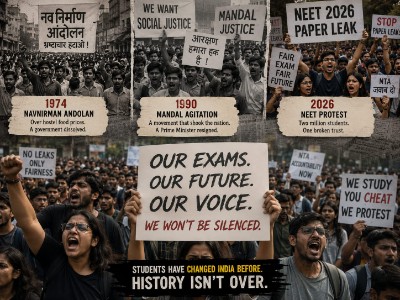
The parents and students India need to talk about...
Not a politician. Not a news anchor. You, the person reading this right now, who probably has a child studying for a competitive exam, or a sibling

Ex-ISRO scientists rewrote India's space history
Pawan Kumar Chandana and Naga Bharath Daka, Skyroot went from a garage startup to a billion-dollar unicorn in just eight years