The Deal That Could Change Everything India Exports
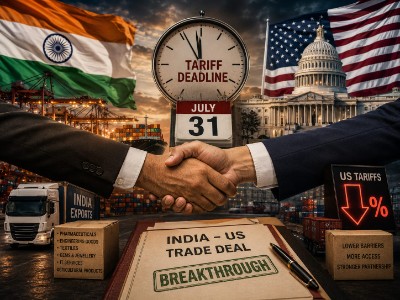
Two days ago, on July 24, 2026, a clock ran out. A temporary tariff arrangement between India and the United States expired, and the two countries still had not signed the trade deal they had been negotiating for months. Yesterday, the Trump administration announced fresh duties of between 10 and 12.5 percent on goods from 60 trading partners, including India, citing forced labour concerns. And on Saturday, India said it would keep engaging with Washington to conclude an agreement anyway.
This is not a small news story for a Saturday morning. It is the opening chapter of one of the most consequential economic negotiations India has conducted since 1991.
How We Got Here
The story begins in February 2026, when Prime Minister Modi visited Washington and the two countries agreed to begin work on the first phase of a Bilateral Trade Agreement, with a shared target called Mission 500, doubling two-way trade to 500 billion dollars by 2030. At the time, the US had imposed a 26 percent reciprocal tariff on Indian goods before announcing a 90-day pause to allow trade talks to proceed. The pause created the window. India and the US spent the next several months trying to climb through it.
Washington eased its reciprocal tariff on Indian goods from 25 percent down to 18 percent as negotiations progressed, and both capitals set the shared Mission 500 target, doubling two-way trade by 2030. Commerce Minister Piyush Goyal and US Trade Representative Jamieson Greer held repeated rounds on market access, agriculture, and non-tariff barriers. US Ambassador to India Sergio Gor described the deal as being in "the final steps, the last 1 percent." The framework was largely ready. The legal text was almost complete.
And then the deadline arrived. And the last 1 percent turned out to be the hardest 1 percent.
What India Was Fighting For
India's negotiating posture throughout these talks has been consistent and worth understanding clearly, because it explains why the deal didn't close on July 24 even when both sides wanted it to.
India was seeking tariff concessions from the United States that provide a comparative advantage over other Asian exporters, specifically Vietnam and ASEAN nations, rather than simply any deal at any terms before any deadline. Indian textile and apparel exporters, one of the country's largest export categories, were particularly concerned about being placed at a disadvantage against Asian rivals under any new tariff regime.
This is the strategic logic that has defined India's entire approach: better terms are worth more than faster terms. A rushed deal that leaves Indian textiles at a competitive disadvantage against Vietnamese or Bangladeshi goods in the American market is worse than no deal at all, because it locks in the disadvantage formally.
The Trump administration on Friday unveiled fresh duties of between 10 and 12.5 percent on goods from 60 trading partners, including India, alleging those countries had failed to curb imports made with forced labour. India immediately said it would continue engaging to conclude the agreement, a signal that New Delhi is treating this new tariff announcement as a negotiating context rather than a dealbreaker.
What Is Actually at Stake for India
The categories most directly affected by the tariff situation, and most directly benefited by a successful trade deal, tell you exactly which parts of India's economy are watching these negotiations most carefully.
Indian textiles, engineering goods, gems and jewellery, pharmaceuticals, and electronics are the primary export categories facing American tariffs. Together, these sectors employ tens of millions of Indians and represent the backbone of India's merchandise export earnings. India's merchandise exports rose approximately 15 percent during April to June 14, 2026, despite global economic uncertainties, reaching 45.2 billion dollars in May 2026, a six-month high. A favourable trade deal with America could accelerate that trajectory significantly. An unfavourable tariff environment could slow it just as effectively.
The timing matters for another reason too. The India-UK trade agreement is moving into force, an India-EU deal is in its final rounds, and live talks with Gulf and Pacific partners are simultaneously under way. India is constructing a web of trade relationships simultaneously, with the US deal as the most consequential single thread in that web. Getting the terms right on this one shapes the leverage and precedent for every other negotiation running in parallel.
The Broader Context Nobody Should Miss
This negotiation is happening against a backdrop that gives India both urgency and leverage simultaneously.
The global supply chain restructuring triggered by Trump's tariff regime has made American companies actively seek manufacturing alternatives to China. India is the most obvious candidate of scale, with the workforce, the democratic governance framework, and the increasingly competitive manufacturing infrastructure to absorb significant production shifts. This is precisely why American companies and American trade negotiators have genuine reasons to want a deal, not just as a favour to India, but as a strategic necessity for American supply chain diversification.
India knows this. Which is why it has been negotiating for terms rather than to a calendar. The urgency is mutual. The leverage is more balanced than a simple reading of the power differential between the two countries would suggest.
The last 1 percent, as anyone who has negotiated anything significant knows, is where the actual value of the entire agreement sits. Every concession on market access, every tariff schedule, every non-tariff barrier that gets resolved in those final pages is worth billions of dollars annually to real Indian exporters and real Indian workers.
India didn't rush. The clock ran out anyway. And now the negotiation continues under a new tariff reality that gives both sides fresh reasons to get the last 1 percent right, before the next deadline starts counting down.


Share Your Comments
Related Posts
The parents and students India need to talk about...
Not a politician. Not a news anchor. You, the person reading this right now, who probably has a child studying for a competitive exam, or a sibling
Ex-ISRO scientists rewrote India's space history
Pawan Kumar Chandana and Naga Bharath Daka, Skyroot went from a garage startup to a billion-dollar unicorn in just eight years

UAE Did It - Will India do it for its future...
The decision makes the UAE the first Arab nation to introduce such ban