The Place Where Buddhism Began Finally Gets the Recognition It Deserved
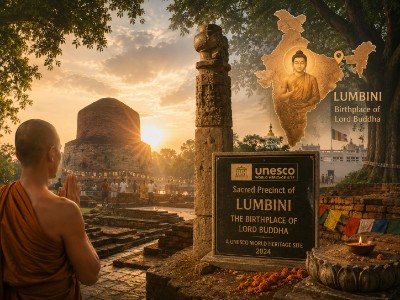
Yesterday, in a conference hall in Busan, South Korea, a delegate stood up and read out a name that has been on a waiting list since 1998. The Ancient Buddhist Site of Sarnath, located ten kilometres northeast of Varanasi in Uttar Pradesh, was officially inscribed on the UNESCO World Heritage List during the 48th session of the World Heritage Committee. India now has 45 UNESCO World Heritage Sites. And a place that gave the world one of its most enduring philosophical and spiritual traditions has finally been recognised by the most authoritative cultural body on Earth.
It took 28 years. It was worth every one of them.
The Place Where Everything Changed
To understand why this inscription matters, you need to understand what actually happened at Sarnath approximately 2,500 years ago, because what happened there did not stay in Sarnath. It travelled across Asia, across centuries, and eventually across the entire world.
Sarnath is revered as the place where Gautama Buddha delivered his first sermon, the Dhammachakkappavattana Sutta, after attaining enlightenment at Bodh Gaya, marking the beginning of the Buddhist Sangha. Known in Buddhist texts as Rishipatana and Mrigadava, which translates as the Deer Park, the site was where the Buddha chose to share his realisation not in solitude but with five companions who had previously abandoned him. That choice to teach rather than remain silent changed the course of human history.
It was here that the Buddha explained the Four Noble Truths, taught the Eightfold Path to achieve liberation from suffering, and advocated the Middle Path between extreme asceticism and indulgence. The first Buddhist community, or Sangha, was established at this very spot when Yasa, the son of a wealthy merchant, and his 54 friends became followers of the Buddha, creating the foundation for one of the world's major religions that today claims approximately 500 million adherents globally.
Sarnath is one of the four holiest Buddhist pilgrimage sites alongside Lumbini, Bodh Gaya, and Kushinagara, associated respectively with the birth, enlightenment, first sermon, and death of the Buddha. Of these four sites, Sarnath is arguably the most philosophically significant: it is not where the Buddha was born or where he died, but where he decided to share what he had discovered. The sermon at Sarnath is why Buddhism exists as a living tradition at all.
What Ashoka Built, and What Survived
Emperor Ashoka, who ruled from 268 to 232 BCE, arrived at Sarnath and erected the famous Lion Capital Pillar, now India's National Emblem, and built stupas and monasteries across the site, transforming a place of spiritual significance into a monumental complex of extraordinary architectural ambition.
The Lion Capital that sits atop Ashoka's pillar at Sarnath, the four lions back to back above the Dharma Chakra, is now housed in the Sarnath Archaeological Museum. It is the same image that appears on every Indian passport, every currency note, and the national seal. Every time an Indian looks at the official symbols of their republic, they are looking at something Ashoka built at Sarnath in the third century BCE to mark the spot where the wheel of Dharma first turned.
The site was sacked and burned around the 12th century CE, with some historians attributing the destruction to Qutb-ud-din Aibek's invasion of 1193 CE, after which monks fled and the site fell into ruin for nearly seven centuries. What the Dhamek Stupa, the Ashoka Pillar, the ruins of monasteries, and the museum together represent today is not just what survived that destruction, but the extraordinary recovery of a site from complete obscurity to global recognition.
The 28-Year Wait That Is Now Over
Sarnath has been on UNESCO's tentative list since 1998, meaning it spent 28 years waiting for formal inscription. India submitted its official nomination dossier titled Ancient Buddhist Site, Sarnath to the UNESCO World Heritage Centre for the 2025-26 nomination cycle in August 2025. The announcement was made during the 48th session of the World Heritage Committee in Busan, South Korea, running from July 19 to 29, 2026.
UNESCO itself welcomed the inscription with a statement: "For more than 2,500 years, Sarnath has been a place of pilgrimage and inspiration for Buddhists around the world. It is here that the Buddha delivered his first sermon, sharing teachings of compassion, wisdom and peace that continue to resonate today."
Prime Minister Narendra Modi hailed the inscription, saying Sarnath's association with Lord Buddha, whose timeless message of wisdom, compassion, and harmony inspires the world, would now encourage more people globally to visit and connect with the ideals of Buddha. India's Ambassador to UNESCO Vishal V. Sharma expressed gratitude to the Archaeological Survey of India and the World Heritage Centre for their sustained efforts in securing the recognition.
What This Means Beyond the Certificate
A UNESCO World Heritage inscription is not merely honorary. It carries practical consequences that matter for a site's long-term survival and global visibility.
Inscription brings increased international tourism, which generates revenue for preservation and for the local communities whose livelihoods depend on pilgrimage and heritage tourism. It brings access to UNESCO's international technical assistance programs for conservation. It places the site on the global cultural itinerary of Buddhist pilgrims from Thailand, Japan, Sri Lanka, Myanmar, South Korea, and beyond, millions of people who treat the four sacred Buddhist sites as a lifetime pilgrimage circuit and who will now have formal, globally recognised confirmation of Sarnath's place in that circuit.
For Varanasi, already one of India's most visited cities, Sarnath's inscription creates an additional cultural anchor that extends tourist stays, deepens engagement with the region's heritage, and adds a globally certified landmark to what is already one of humanity's oldest continuously inhabited cities.
The ASI will also install a new plaque crediting Babu Jagat Singh, who lived from 1787 to 1788, for bringing Sarnath's archaeological importance to light, correcting an earlier attribution to the British. That correction is its own quiet statement: India's heritage belongs to India, was noticed by Indians, and is now recognised by the world.
The deer still graze in the sculptures at Sarnath's museum. The Dhamek Stupa still stands where the wheel first turned. And as of yesterday, the world has formally agreed on what people have known for 2,500 years: this is one of the most important places on Earth.


Share Your Comments
Related Posts

The Deal That Could Change Everything India Exports
The clock ran out, the tariffs arrived, and India still won't sign a bad deal, here's what the collapsed July 24 deadline actually means for your economy.

The parents and students India need to talk about...
Not a politician. Not a news anchor. You, the person reading this right now, who probably has a child studying for a competitive exam, or a sibling
Ex-ISRO scientists rewrote India's space history
Pawan Kumar Chandana and Naga Bharath Daka, Skyroot went from a garage startup to a billion-dollar unicorn in just eight years