Students project hijacked by corrupt politicians...
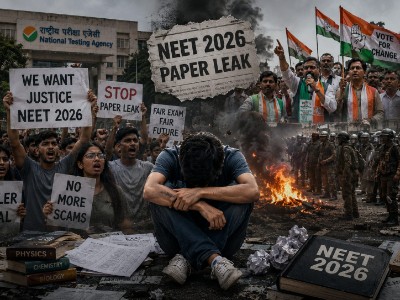
Somewhere in India right now, a 19-year-old is sitting in a small room in Kota or Patna or Sikar, surrounded by biology textbooks and handwritten notes, having studied for three years straight, having watched her parents quietly cut expenses they never mentioned cutting, having missed weddings and festivals and every casual evening that her friends took for granted, because she believed in one thing: that if she worked hard enough, the exam would be fair.
She was wrong. And the people who promised to fight for her have, one by one, made her cause about everything except her.
The Legitimate Wound That Started Everything
Let's be absolutely clear about where this begins, because clarity matters when everything that follows is so murky. NEET 2026's paper was scheduled for 3 May. By 7 May, Rajasthan's police chief had a tip-off about a guess paper in circulation. That paper had 410 questions, of which 120 matched the actual exam paper exactly, with identical answer options, all traced back to Sikar district. By 12 May, the CBI had registered a case.
120 questions out of 180 in the real paper had been leaked. Not rumoured. Not alleged. Leaked, with identical answer options, in the hands of people who paid for them before the exam began. Millions of students who had spent years preparing competed on a tilted ground without knowing the ground was tilted. Their futures were compromised before they had sat down to write.
This was real. This was legitimate. This demanded accountability. Senior advocate Shri Randhir Lal Sharma, who has been following this issue closely, said it plainly: this protest began as a pure and genuine student movement. Young people whose futures were stolen by a broken system had every right to be furious, every right to march, and every right to demand answers. Their anger was not manufactured. It was earned, drop by drop, over years of sacrifice.
The Moment It Stopped Being About Students
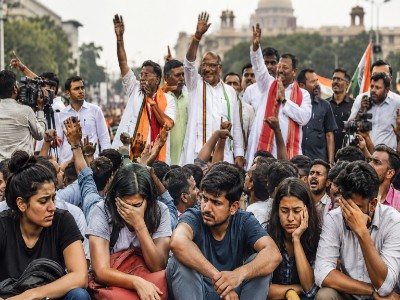
Watch the footage from Jantar Mantar on 19 and 20 July 2026, and ask yourself one question: how many of these faces belong to students preparing for NEET?
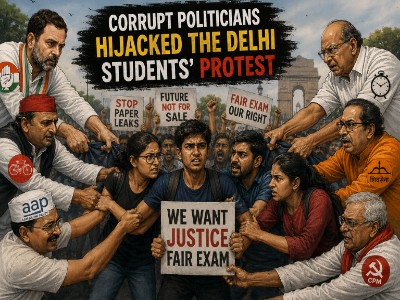
Thousands gathered in New Delhi under the banner of the Cockroach Janata Party, a pseudo-political outfit, with Congress, Samajwadi Party, AAP, NCP, Shiv Sena UBT, and CPM all sending their leaders and workers to participate. Rahul Gandhi and Mallikarjun Kharge staged a sit-in outside the Prime Minister's residence. Akhilesh Yadav joined them. Arvind Kejriwal appeared at Jantar Mantar. Sharad Pawar's daughter Supriya Sule was photographed at multiple protest sites in a single day.
These are not NEET aspirants. These are political parties who saw a wound and chose to pour into it, not to heal it, but to use its heat for their own warmth.
Viral footage captured a Nihang extremist at the protest threatening to beat law enforcement personnel until covered in bruises, raising deeply alarming questions about how armed external provocateurs infiltrated what was supposed to be a student demonstration about exam integrity. At Tolstoy Marg in Connaught Place, miscreants attacked police personnel with stones and bottles. Connaught Place ACP Vivek Bhagat sustained injuries and was rushed to RML Hospital. Visuals showed broken barricades, stone pelting, damaged buses, shattered police vehicles, and coordinated assaults on officers who were standing between the crowd and Parliament.
Police personnel were beaten on the streets of India's capital in the name of students who never asked for this.
The Questions Nobody Is Asking
Here is what Advocate Randhir Lal Sharma has pointed out, and what deserves to be said loudly in every forum where this protest is being discussed: if this is truly about students, why is nobody talking about Punjab?
Paper leaks are not a new or isolated phenomenon.
Punjab, governed by AAP, has its own examination irregularity record. Jharkhand, governed by JMM, has its own paper leak history. Indresh Kumar specifically cited Punjab, Kerala, and Himachal Pradesh as states with comparable examination failures under opposition governance. But not a single politician at Jantar Mantar, not one of the leaders who flew in for the cameras, has mentioned Punjab. Not one has demanded accountability from their own state governments. Not one has asked why the paper leak epidemic has afflicted every kind of government equally.
Because this was never about the epidemic. It was about the election cycle.
What Was Shouted, and What It Revealed
At the protest site, burqa-clad women and activists who showed no knowledge of NEET's actual demands were found chanting slogans exclusively about the Education Minister's resignation and abusing Prime Minister Narendra Modi. When asked about what specific action should be taken to prevent paper leaks, none of them had an answer. They had slogans. They did not have solutions. They did not have the names of the students whose futures were destroyed. They had the name of a minister they wanted removed, which is a different objective entirely.
Reports of derogatory slogans targeting not just politicians but Hindu religious figures circulated widely from the protest site, images and videos that the student community itself, the real NEET aspirants, found deeply uncomfortable. The 19-year-old in that small room in Kota did not ask for her cause to be carried under those slogans. Nobody asked her.
What Justice Actually Looks Like
Advocates position on this is the one that deserves to be remembered after the cameras leave Jantar Mantar. A student movement is legitimate when it stays focused on the students. When it becomes a platform for political mobilisation, when the people speaking the loudest have no personal stake in NEET, when the slogans drift from "fix the exam system" to "remove this minister so we can install ours," the students have been abandoned twice: first by the system that leaked their paper, and second by the politicians who promised to fight for them and quietly used their pain as campaign material.
The NEET crisis is not one event. It is the accumulated consequence of a broken examination ecosystem that has failed students across years, across states, across governments of every political colour. Fixing it requires systemic reform: independent examination bodies, decentralised question paper systems, technological safeguards, and above all, the willingness to hold every state government accountable, not just the ones you happen to be running against in the next election.
The student in that small room in Kota deserves exactly that. She does not deserve to watch politicians use her three years of sacrifice as a prop in a press conference, disappear when the cameras leave, and never once mention that Punjab exists.
Her cause was real. It still is. But it was stolen from her before anyone had the decency to tell her it was happening.

Share Your Comments
Related Posts
America's Top Diplomat Visits Mother Teresa's Kolkata — And Then Heads to Delhi With a Full Agenda
It was his initiative to come to the Mother House, and it was a joy for us to welcome him because he wanted to receive blessings at Mother's tomb. We prayed together, and that is about all.
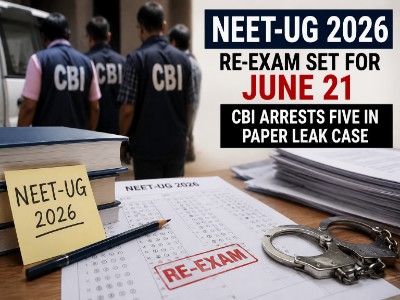
NEET-UG 2026 Re-Exam Set for June 21 - CBI Arrests Five in Paper Leak Case
The Rajasthan Special Operations Group found a set of over 400 questions circulating before the exam