The Quiet Revolution That Made God Accessible To Everyone
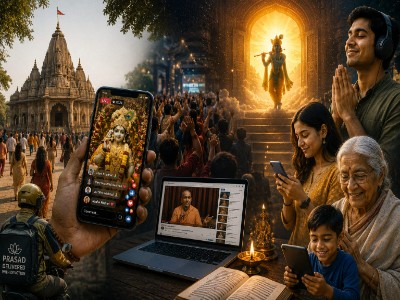
Long before India had social reformers writing pamphlets or leading marches, it had poet-saints singing songs of pure love for God in village squares, songs so simple and heartfelt that a farmer, a weaver, or a washerman could understand them just as easily as a Sanskrit-trained priest. This was the Bhakti movement history, and through Bhakti saints India like Kabir and Mirabai, along with the enduring reach of devotional poetry Bhakti and figures central to Bhakti movement significance, it quietly reshaped Indian spiritual and social life for nearly a thousand years.
Where it all began
The word "bhakti" itself simply means devotion, a deep, personal, emotional bond between a devotee and God. The movement traces its roots to South India, emerging as early as the 7th century in present-day Tamil Nadu, carried forward by two remarkable groups of poet-saints: the Alvars, devoted to Lord Vishnu, and the Nayanars, devoted to Lord Shiva. What made them radical for their time was refreshingly simple, they composed devotional hymns not in formal Sanskrit, the language of priests and scholars, but in Tamil, the language ordinary people actually spoke at home. For the first time, spiritual expression didn't require a Brahmin intermediary or elaborate ritual knowledge, it just required love.
Why this movement caught fire
To understand why Bhakti spread so powerfully, you have to picture medieval Indian society as it actually was: heavily stratified by caste, weighed down by complex rituals that only the privileged few could properly perform, and increasingly dominated by priestly gatekeeping over who got to access the divine. Alongside this, the arrival of Islam in India brought its own emphasis on monotheism and equality before God, ideas that resonated with reformers already questioning rigid social hierarchies. Out of this mix emerged a genuine hunger for a simpler, more inclusive form of worship, one where a person's caste, gender, or social standing didn't determine their closeness to the divine.
The saints who carried the torch north
From its southern roots, Bhakti gradually travelled across the subcontinent, adapting to local languages and cultures wherever it went. In Karnataka, the 12th-century saint Basavanna rejected caste and gender discrimination outright, founding the Lingayat community and creating the Anubhava Mantapa, a remarkable public hall where people from every social background could gather and openly discuss spiritual and everyday questions together, centuries before such open dialogue became commonplace. In Maharashtra, saints like Namdev spread devotion through soulful hymns. By the time the movement reached its peak in North India between the 13th and 17th centuries, it had produced some of Indian literature's most beloved names: Kabir, whose verses beautifully blended Hindu and Islamic spiritual thought while insisting on a direct, personal relationship with God; Mirabai, the Rajasthani princess whose passionate devotional poetry for Krishna defied royal and social expectations of her; Tulsidas, whose Awadhi retelling of the Ramayana made the epic accessible to millions who couldn't read Sanskrit; and Surdas, the blind poet whose lyrical compositions on Krishna's childhood remain treasured today. Guru Nanak, founder of Sikhism, also emerged from this broader devotional current, further emphasising devotion to one formless God and genuine social equality.
What made Bhakti genuinely different
At its heart, Bhakti rejected the idea that reaching God required elaborate sacrifices, expensive rituals, or priestly permission. Instead, it insisted that sincere love and surrender alone were enough, and that God responded to genuine devotion regardless of who was offering it. This philosophy had real, tangible social consequences. Many Bhakti saints themselves came from lower castes or marginalised backgrounds, and their rise directly challenged the Brahmanical monopoly over religious authority. Historians have often compared the movement to Europe's Protestant Reformation, in the way it pushed back against rigid religious hierarchy and made spiritual practice a personal, democratic experience rather than an institutional one.
Why Bhakti still matters today
The legacy of this movement runs far deeper than religious history alone. By choosing to compose in regional languages, Tamil, Hindi, Marathi, Assamese, Kannada, Bhakti saints essentially built the foundation for much of India's rich vernacular literary tradition, giving ordinary people access to poetry, music, and philosophy in their own mother tongues for the first time. The bhajans and kirtans sung in temples across India today, the emotional, melodic devotional singing that unites strangers in a shared moment of worship, trace their lineage directly back to this movement. Even India's broader cultural instinct toward religious pluralism and personal spirituality over rigid dogma owes something to these poet-saints, who insisted, centuries before it became fashionable to say so, that the divine, at the very core of Bhakti movement history and Bhakti movement significance, belongs equally to everyone, not just the privileged few.


Share Your Comments
Related Posts

Getting A Job In India Just Got Weirder- Fewer Freshers Wanted, But More Jobs Than Ever
Why India's job market is growing overall even as entry-level opportunities shrink, and what skills-first hiring means for freshers.

Same Win, Different Headline: How Western Media Frames India’s Success...
When India's Mangalyaan probe successfully entered Mars orbit in 2014

So What If It's "Propaganda"? Maybe India Just Deserves To See Itself Win For Once
Why calling patriotic Bollywood hits like Dhurandhar "propaganda" ignores the double standard in how India's wins versus struggles get judged on screen.