India We Need to Talk...
Let us ask you something directly. Not a politician. Not a news anchor. You, the person reading this right now, who probably has a child studying for a competitive exam, or a sibling who just finished one, or a memory of your own years buried in textbooks believing that the system would be fair if you worked hard enough.
When was the last time a student protest in India actually changed something? And more importantly: is this one going to?
The Times Students Actually Moved Mountains
Let's go back. Because India has a history of student protests that did not end in press conferences and forgotten hashtags. Some of them genuinely shook the foundations of the republic.
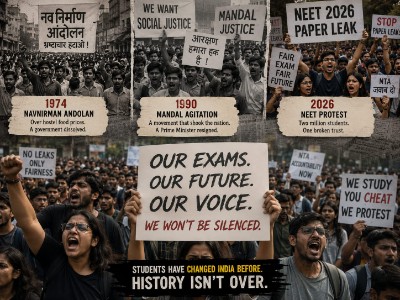
In 1974, it started with a 20 percent hike in hostel food charges at an engineering college in Ahmedabad. Students took to the streets. The protests grew until the Indira Gandhi government asked the Gujarat Chief Minister Chimanbhai Patel to resign, and the state government was dissolved entirely. A hostel food price. That's all it took to dissolve a state government. Not because the students had political backing. Because they had moral clarity and they refused to go home.
That movement became the Navnirman Andolan, which fed directly into the JP movement, which fed directly into the Emergency, which produced an entire generation of politicians still running this country today. Narendra Modi, who is now Prime Minister, cut his political teeth in that exact student movement. So did Lalu Prasad. So did Nitish Kumar. An entire generation of India's political leaders emerged from the Jayaprakash Narayan movement against the Emergency declared by Indira Gandhi on June 25, 1975. Students did not just change a government that time. They changed the direction of Indian democracy itself.
Then came 1990. When VP Singh implemented the Mandal Commission recommendations and announced 27 percent reservation for OBCs, students poured onto the streets of Delhi, Lucknow, and dozens of other cities. A 19-year-old named Rajeev Goswami set himself on fire outside Deshbandhu College. Monica Chadha, also 19, poured gasoline on herself. Even on her deathbed she said: "Today I want to teach a lesson to VP Singh. I am proud of what I have done."
The agitation ended when VP Singh resigned on 7 November 1990 after the BJP withdrew support from his government. A Prime Minister resigned. Not an Education Minister. A Prime Minister. And the resignation was connected, directly and undeniably, to the pressure of a student movement.
So yes. It has happened. In India. Students have dissolved state governments. Students have contributed to the fall of Prime Ministers. The Assam agitation produced the Assam Accord, signed in 1985, and the National Register of Citizens in Assam is a direct outcome of that student movement. Students rewrote the citizenship architecture of an entire state.
Now Ask Yourself: Is This One the Same?
We are asking you honestly. Look at what is happening at Jantar Mantar right now and compare it to those moments. In 1974 and 1990, the protests were led by students, about students, with demands that never drifted from the original cause. The leaders of those movements had no political party providing them food, no opposition politicians flying in for photographs, no organized apparatus distributing provisions via food delivery apps.
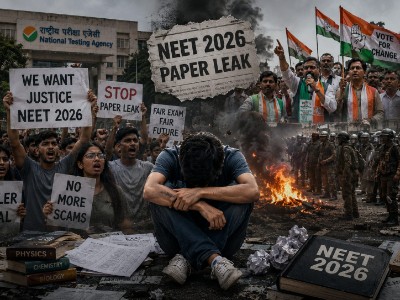
For six weeks, genuine students have been camping at Jantar Mantar. PhD students from JNU and Allahabad University went on 23-day hunger strikes. Sonam Wangchuk fasted until his health deteriorated and police forcibly took him to hospital. More than 100 students were injured when police used tear gas and batons on July 20. These are real people paying real prices for a real cause.
But here is the question India needs to sit with: Britain has had seven Prime Ministers in ten years, with ministers routinely resigning when they fail their responsibilities. In India, the Education Minister has not resigned. The Prime Minister has announced fast-track courts but offered no apology for the police crackdown and no indication that officers accused of excessive force will be investigated.
So what is different this time? Why did a hostel food hike produce a resigned Chief Minister in 1974, and a leaked exam paper affecting two million students is being met with tear gas and political theater in 2026?
The Question Only You Can Answer
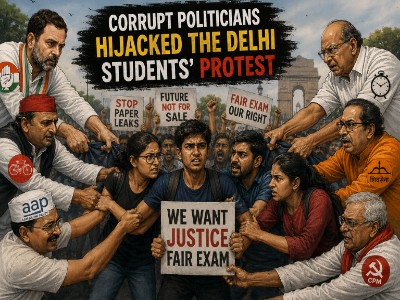
Senior advocate Shri Randhir Lal Sharma has said what many people privately believe: this protest began as a pure student movement and was hijacked. The same politicians now staging sit-ins outside the Prime Minister's residence have governed states where paper leaks happened on their own watch. Nobody is asking about Punjab. Nobody is asking about Jharkhand. The microphone goes to whoever is speaking loudest, not to whoever has the cleanest hands.
But here is the deeper question we want to leave with you, the reader, not the politician, not the anchor, you:
In 1990, students set themselves on fire for their cause. In 2026, political parties are setting up food stalls at the protest site. Does that difference tell you something about who this protest now belongs to?
The two million students who had to resit NEET because someone sold their exam paper deserve the same fierce, undiluted, politically uncontaminated outrage that Rajeev Goswami expressed in 1990. They deserve a movement that stays about them, that doesn't drift into slogans about Prime Ministers and Home Ministers, that doesn't get photographed next to party flags, that doesn't go silent when you ask about Punjab.
India has proof that student power works. It has changed governments. It has rewritten policy. It has produced accords that still govern states today.
But it only worked when it stayed honest about what it was for.
Is this protest still that? You tell us.

Share Your Comments
Related Posts
Ex-ISRO scientists rewrote India's space history
Pawan Kumar Chandana and Naga Bharath Daka, Skyroot went from a garage startup to a billion-dollar unicorn in just eight years
UAE Did It - Will India do it for its future...
The decision makes the UAE the first Arab nation to introduce such ban
_400x300_(1).jpeg)
Pakistan Is Happier Than India?
Do you really want to believe that a country facing civil unrest ranks higher than India on an international media or governance index?